| Back OpEdNews | |||||||
|
Original Content at https://www.opednews.com/articles/The-End-Of-Global-Economic-by-Dr-Stuart-Jeanne-B-111101-666.html (Note: You can view every article as one long page if you sign up as an Advocate Member, or higher). |
|||||||
November 1, 2011
The End Of Global Economic Growth
By Dr Stuart Jeanne Bramhall
In Heinberg's previous work on resource scarcity, he envisions a timeline of a decade or more before the scarcity and prohibitive cost of natural resources (oil, coal, water, etc.) cause the capitalist economic system to hit the wall. In The End of Growth, he argues that it has already happened -- when global economic expansion ended in October 2008. His data shows that while a few countries can claim an occasional quarter of
::::::::
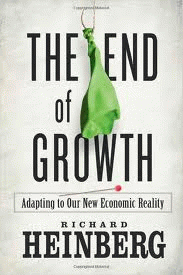
Book Review
The End of Growth: Adapting to Our New Economic Reality
by Richard Heinberg
(New Society Publishers Aug 2011)
The basic premise of The End of Growth is that the world economy has flat-lined. Not only is it contracting, rather than expanding as many politicians claim, but there are important reasons why it will never return to the pre-2007 growth rates that characterized the last century.
Now that #OccupyWallStreet has seized control of the narrative around the banks that control the US government, the End of Growth will likely be the most important book of 2011. As well as making an ironclad case that the era of perpetual economic expansion has ended -- that the US, like most western nations, has become a Steady State economy -- Heinberg also gives examples of far-sighted governments (Japan, Sweden, Denmark, Norway and Finland) who have enacted policies to ensure the welfare of their citizenry as they confront the massive downsizing required by this new economic reality. Beyond organizing to end to corporate rule, #OccupyWallStreet needs to pressure the US and other western governments to abandon the pretense and enact similar measures.
Why Capitalism Hit the Wall in 2008
Heinberg and others in the Peak Oil/climate change movement have always argued that infinite economic expansion is mathematically impossible, given that we live on a planet with finite natural resources. They point to the massive ecological devastation caused by this reckless obsession with economic growth and warn that we are depriving our children and grandchildren of natural resources (fossil fuels, water, industrial fertilizers, fish stocks, top soil) that are essential for basic survival.
In Heinberg's previous work on resource scarcity, he envisions a timeline of a decade or more before the scarcity and prohibitive cost of natural resources (oil, coal, water, etc.) cause the capitalist economic system to hit the wall. In The End of Growth, he argues that it has already happened -- when global economic expansion ended in October 2008. His data shows that while a few countries can claim an occasional quarter of increased GDP, aggregate global economic growth is either stagnant or slowly contracting. Even China's so-called economic "miracle" hasn't been sufficient to generate a genuine increase in total global wealth.
Heinberg's new book is unique is that it combines his extensive research into resource depletion with an analysis of our flawed fractional reserve banking system. He is also the first, to my knowledge, to factor in the immense cost of the growing epidemic of natural disasters. Most (the floods, droughts, wildfires, landslides, etc.) relate to climate change. However some, like last year's Gulf oil spill, relate to the depletion of global oil and gas resources and the adoption of riskier methods of fossil fuel extraction.
In addition to quoting a number of highly placed financial business experts, like Microsoft CEO Steve Bollmar, who agree that global economic expansion has permanently ended, Heinberg also presents a wealth of statistical data. This includes graphs from John Williams of www.shadowstats.com, who argues that the US government is misrepresenting the true Gross Domestic Product (GDP), just like they misrepresent the true unemployment rate -- which is really 16-18%. According to Williams, after government figures are adjusted for inflation and methodological reporting changes, 2010 GDP actually decreased by 1%.
The Ultimate Ponzi Scheme
Even a look at conventional World Bank and IMF data leaves the clear sense that the American public is being systemically lied to. Although we are told that total global wealth has nearly returned to its 2007 high of $63 trillion, this figure doesn't take account of the $40 trillion owed by the US and other governments nor the $60 trillion of debt owed by banks, businesses and households. Even if global GDP does increase by 3% per year (which, as Heinberg clearly shows, it won't), 3% of $63 trillion barely covers interest payments on a $100 trillion debt, much less paying down the original loans.
Yet as Heinberg points out, none of these numbers represent true wealth. Under the fractional reserve lending system, this debt has been invented out of thin air by banks to generate interest payments. As he points out, it's the ultimate Ponzi pyramid scheme. It only works so long as suckers keep putting money into it. In a global monetary system where money is created through bank loans, there is never enough money in the system to pay back all the debts with interest. This type of system can only continue to function so long as there is continued growth. It's precisely because economic expansion has stopped, Heinberg argues, that the world confronts its current massive debt crisis.
A Basic Lesson in Economics
Heinberg's analysis of the 2008 economic collapse starts with an introduction to classical economic theory, as outlined by Adam Smith, Ricardo, Malthus and Marx. He goes on to describe the "financialization" of the US economy that occurred in the 1980s, the various financial derivatives investment banks and brokers devised to entice investors, and the financial deregulation that led to a decade of worsening "debt" bubbles. Beginning with the dot com boom in 2000 (quickly followed by the real estate boom and the subprime/derivative boom), large amounts of borrowed money was speculated on supposed growth industries, which plunged the entire economy into recession when they collapsed.
Heinberg talks in detail about the TARP bailouts and the secret $12.5 bailouts Bernie Saunders exposed in December 2010. He stresses that have merely postponed total economic collapse. They are incapable of restoring economic expansion to pre-2007 levels.
The End of Growth in China
He then presents a painstaking analysis of why the China's current phenomenal growth rate (7-8% per year) and somewhat slower growth rates in India, Thailand, Malaysia and Vietnam also represent "bubbles" that will eventually pop and cause severe recession. As well as outlining the absolute limits resource scarcity will impose on Chinese growth, he argues that China is pursuing the same economic strategies that caused the Japanese economic miracle to collapse in the 1990s -- resulting in a two decade long recession.
Chinese economic growth is entirely dependent on cheap coal and electricity, and Heinberg lays out strong evidence that world coal production peaked earlier this year. This means coal will soon undergo the same steep rise in prices that oil did after oil production peaked in 2005-2006. He also shows how the current Chinese growth spurt is driven by same economic policies -- an export driven economy where Chinese consumers must sacrifice and save to protect export industries -- that drove Japan's post-war growth. The outcome of such policies is to crush consumer demand. This, in turn, results in rapid economic contraction when global demand for exports drops.
Heinberg concludes by describing China's current real estate bubble (which translates into hundreds of empty malls, factories and cities), which was created by two factors 1) a stimulus package the government enacted when the 2008 global collapse triggered a drop in Chinese exports 2) a preference the Chinese middle class show for real estate investments, owing to a notoriously unreliable (and unregulated) share market.
As China is one of New Zealand's trading partners, we're already seeing evidence that the Chinese growth rate has peaked and is beginning to decline. There has been a significant drop in Chinese demand for our dairy and lamb exports -- dairy exports and prices have declined by 10% and lamb by 20%.
Life in a Steady State Economy
Obviously the end of economic growth and continuing loss of wealth and jobs means that people in most industrialized countries will be forced to massively downsize their lifestyles. However, as Heinberg emphasizes, there are a number of ways government can intervene to make this transition less painful. He gives examples of countries (Japan, Sweden, Denmark, Japan, Norway) who openly acknowledge that they have Steady State economies and enact policies to ensure their populations are looked after as the global economy massively contracts. Sweden, for example, has transformed depressed industrial towns into "ecomunicpalities" by "dematerializing' their economies, making them fossil fuel-free with organic farming, public transportation and alternative energy projects -- while simultaneously fostering social equity.
Although Finland and Germany had modest GDP increases last year, they are adopting similar measures to protect their citizenry as global economic wealth continues to decline. In addition to preserving scarce natural resources and reducing carbon emissions, these measures also address the serious income inequality that is so harmful to the health of communities. They include, among others:
- Requiring corporations to pay fairer prices on mining and fossil fuel extraction
- Taxing resource depletion, pollution, speculation and financial transactions instead of income
- Legislating limits on income inequality
- Government subsidies to help sustainable businesses become competitive with non-sustainable ones
- Pigovian taxes on corporations equal to the negative, externalized costs they impose on society.
- Defining property rights in a way that guarantee citizens rights to clean air and water
- Breaking up investment banks, and eliminating of debt-based lending (to government, businesses and individuals) through the creation of national and state banks
- Government support for cooperatives and local currencies
- Downgrading the World Bank and IMF to clearing houses
- Corporate law reform
- Replacement of GDP with the Gross National Happiness Index
- Publicly subsidized health care
Authors Website: http://www.stuartbramhall.com
Authors Bio:
I am a 63 year old American child and adolescent psychiatrist and political refugee in New Zealand. I have just published a young adult novel THE BATTLE FOR TOMORROW (which won a NABE Pinnacle Achievement Award) about a 16 year old girl who participates in the blockade and occupation of the US Capitol. I also have a new non-fiction ebook REVOLUTIONARY CHANGE and a 2010 memoir, THE MOST REVOLUTIONARY ACT: MEMOIR OF AN AMERICAN REFUGEE describing the circumstances that led me to leave the US in 2002 to start a new life in New Zealand. My memoir won an Allbooks Review Editor's Choice Award. I have a political commentary blog at my website.