| Back OpEdNews | |||||||
|
Original Content at https://www.opednews.com/articles/Reclaiming-Adam-Smith-by-Dr-Stuart-Jeanne-B-111001-512.html (Note: You can view every article as one long page if you sign up as an Advocate Member, or higher). |
|||||||
October 1, 2011
Reclaiming Adam Smith
By Dr Stuart Jeanne Bramhall
It's high time for liberals, progressives and left libertarians to reclaim Adam Smith as one of our own. In the Wealth of Nations, Smith self-identifies as a liberal, advocates for what he calls "progressive" economics, and calls for government intervention to ensure that rich people invest their profits in increasing productive labor, rather than luxury, corruption and vice.
::::::::
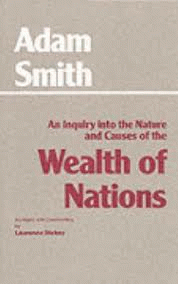
Book Review
The Wealth of Nations
by Adam Smith
Abridged Version by Laurence Dickey, Professor of History, University of Wisconsin-Madison (Hackett Publishing 1993)
The Wealth of Nations consists of five books (written between 1767-1777, with the publication of the third and final edition in 1784). Neoliberals and neoconversatives frequent Smith's major work to justify ending government regulation of corporations. They argue that regulation negatively impacts the totally unobstructed free market Adam Smith allegedly advocates.
I think it's high time for liberals, progressives and left libertarians to reclaim Adam Smith as one of our own. Smith self-identifies as a liberal -- one of the first in Europe. He also makes frequent positive reference to what he calls "progressive" economics and "doux-commerce," which calls on government intervention to ensure that rich people invest their profits in increasing productive labor, rather than luxury, corruption and vice.
The 1993 Edition
Smith's writing tends to be somewhat repetitive, as large sections of the later books predate the earlier ones. In his abridged version, Dickey merely summarizes material Smith has introduced in earlier sections. There is also a generous preface, as well as appendices, that position Smith among the various writers of the 18th century Scottish Enlightenment. In this way Dickey shows that, to a large extent, the Wealth of Nations is a consolidation of widely held contemporaneous views on economics.
The overall intent of the Wealth of Nations is 1) to make general observations about the economic and social changes that underlay the transformation from feudalism to modern industrial society and 2) to lay out fundamental macroeconomic principles based on these observations that Smith believes are essential for a prosperous, political stable nation capable of providing an adequate standard of living for its workforce. The latter is extremely important to Smith, both as a principle of social justice and to prevent social unrest.
Smith definitely does not, as claimed by many neocons and neoliberals argue for the need or even desirability of a totally unregulated free market economy. Quite the contrary, Book V "Revenue of the Sovereign or Commonwealth" makes a strong argument that government intervention is essential in free markets to ensure economic growth and general prosperity.
Book I ("Of the Causes of Improvement in the Productive Powers of Labour")
Book I lays out Smith's belief that "division of labor" -- in which individuals stopped making their own plows, dwellings, shoes, clothes, etc. and organized into specialized trades to provide these services -- was the revolutionary socio-economic change that made modern economic development and western-style democracy possible. Smith describes in detail the early development of trade (in nations with access to the sea and inland waterways) and the origin of money. He also explains how supply and demand work, showing how higher demand leads to higher prices, which leads producers to bring more of their product to market, which, in turn, tends to lower prices. He argues that an under supply of labor leads to increased wages and an oversupply a decrease in population growth.
Smith provides considerable detail from merchant and export records regarding 18th century wages in England, Scotland, France, and North America, as well as the average price of common commodities. Citing the American colonies as an example, he concludes that the wages and welfare of workers is always worse in an established static economy than in one that is growing, i.e. where new land is being put into production and new industries being formed.
He makes a detailed case for slavery being uneconomical. He argues that paying workers directly for their work makes them more productive and results in more capital that can be reinvested in productive labor.
Smith's Advocacy for Social Justice
Book I also lays out Smith's strong views on social justice, which he elaborates further in Book V. He insists that daily "subsistence" (i.e. wages) should be proportioned to daily necessities. "No society can surely be flourishing and happy, of which the far greater part of the members are poor and miserable. It is but equity, besides, that they who feed, clothe and lodge the whole body of the people should have such as share of their own labour as to be themselves totally well fed, clothed and lodged."
Smith's Views on Elite Conspiracies
Smith sounds a lot like Michael Parenti in the observations he makes about elite conspiracies, in which business owners "combine" in secret to agree to hold wages down: "Whoever imagines that masters rarely combine is as ignorant of the world as of this subject."
He makes the point that it's much more difficult for workers to "combine" (i.e. unionize) because of anti-labor laws and urgent subsistence needs.
Falsely Attributing the "Invisible Hand" to Adam Smith
Book II ("Of the Nature, Accumulation and Employment of Stock") lays out Smith's view that capital accumulation (the reinvestment of profits to employ more workers) further advances divisions and subdivisions of labor to improve the "productive power of labor" and the wealth of society. Here Smith emphasizes the importance of spreading wealth to wider and wider circles of people to keep employment constant and prevent social disorder.
The second book also emphasizes what Smith calls "frugality" or the "mediocrity-of-money" as essential to this capitalization as the division of labor. Neoliberals often make Smith out as an advocate of laissez-faire economics, in which economic imbalances and social injustice is addressed by the "invisible hand" of competitive market forces. However, it was actually one of Smith's contemporaries J Harris who made this argument. Although Smith doesn't refer to Harris by name, he is clearly refuting his views in arguing the need of limited government intervention to address social injustice. Smith clearly believes this intervention (which he lays out in detail in Book V) is essential to ensure "doux-commerce." This he defines as an economy based on "frugality," in which rich people invest their profits in increasing productive labor, rather than luxuries, corruption and vice, which contribute nothing to a society's economic well being.
Book III ("of the Different Progress of Opulence in Different Nations") elaborates on Smith's ideas about the accumulation of capital and "frugality," as well as describing the rise of cities and mercantilism, which, in Smith's view, negatively impacts investment in agriculture. Using numerous historical examples, he argues that the inability of a country or empire to produce their own food (and subsequent reliance on food imports) always results in their downfall.
Smith's Attack on Mercantalism, Monopolies, Tariffs, and Quotas
Book IV ("Of Systems of Political Oeconomy") is an attack on mercantilism, which Smith despises. "Monopoly," according to Smith, "is the sole engine of the mercantile system." Smith, who makes the strong argument that money has no intrinsic value of its own, blames mercantilism on an overemphasis on accumulating gold and silver reserves (money), at the expense of genuine productive capacity and overall economic wealth. He's highly critical of European nations for being obsessed with a positive balance of trade (to build up their gold and silver reserves). He's also critical of the wrongheaded way they go about it, through the granting of monopoly rights and protective tariffs, and quotas, which always negatively impact domestic production.
Smith is a strong "free trade" advocate, and his famous description of the free market, which neoliberals frequently quote out of context, comes from Book IV: "Every man, as long as he doesn't violate the laws of justice, is left perfectly free to pursue his own interest in his own way, and to bring both his industry and capital with those of any other man, or order of men."
Smith feels that if international market forces are left to their own devices there is a natural flow of wealth from rich to poor countries. When rich countries resist this, there is a loss of flexibility and innovation, in addition to the decline in the domestic economy -- particularly agriculture -- which is essential for a nation's wealth. This failure to invest in agriculture leads to higher prices for food and other necessities required by workers.
Smith's Case for Government Regulation
Smith lays out his views on government intervention in Book IV, which he elaborates in Book V.
According to Smith, a sovereign (government) has three duties:
- To protect society from violence or invasion
- To protect, as far as possible, every member of society from injustice or oppression from every other member of society (His use of the word "oppression," rather than "violence," is interesting. From the context, it's clear that Smith is referring to economic oppression and social injustice).
- To maintain certain public works and institutions, "which can never be for [the benefit of] certain individuals or groups of individuals." (Smith makes this argument on economic grounds -- if you allow rich people to be the sole beneficiaries of public institutions, it becomes impossible to recoup the expense).
In Book IV, Smith also calls for direct government intervention in "facilitating" investment in agriculture.
Linking Economic Policies and Social Justice
Book V ("Of the Revenue of the Sovereign or Commonwealth") is mainly about social injustice. It elaborates on the interventions Smith would allow the government to make in the affairs of society and economy. These fall mainly into two categories:
1) Ensuring justice in relations between the rich and poor.
2) Taking charge of educational institutions to provide moral up-lift -- a culture of "frugality" throughout the society -- in the name of social justice.
Smith feels that educating common people in civilized society is more important than educating the rich. He believes rudimentary education is essential in preventing the formation of "religious sects" that can often lead to social unrest. At same time, he emphasizes importance of privately funded advanced education (for the wealthy). He gives numerous examples of private funding improving quality of teaching (by pressuring teachers to work harder).
The fifth and final book delves at length into the effect of military spending on economic wealth. It talks about the extreme risk a standing army poses to democracy (Smith gives Rome and Cromwell's parliament as examples). He allows that with advanced military technology, a standing army may be necessary, as militia members have other occupations that prevent them from engaging in extensive training. However he argues that military spending must be strictly limited and never funded by borrowing. He predicts that indebtedness for military spending will eventually cause the economic ruin of all European countries.
Authors Website: http://www.stuartbramhall.com
Authors Bio:
I am a 63 year old American child and adolescent psychiatrist and political refugee in New Zealand. I have just published a young adult novel THE BATTLE FOR TOMORROW (which won a NABE Pinnacle Achievement Award) about a 16 year old girl who participates in the blockade and occupation of the US Capitol. I also have a new non-fiction ebook REVOLUTIONARY CHANGE and a 2010 memoir, THE MOST REVOLUTIONARY ACT: MEMOIR OF AN AMERICAN REFUGEE describing the circumstances that led me to leave the US in 2002 to start a new life in New Zealand. My memoir won an Allbooks Review Editor's Choice Award. I have a political commentary blog at my website.