| Back OpEdNews | |||||||
|
Original Content at https://www.opednews.com/articles/A-To-Do-List-for-US-Troo-by-Georgianne-Nienabe-110406-94.html (Note: You can view every article as one long page if you sign up as an Advocate Member, or higher). |
|||||||
April 6, 2011
A 'To Do' List for US Troops Now Arriving in Haiti
By Georgianne Nienaber
Depending on the source, up to 300 US troops now have "boots on the ground" in Haiti in anticipation of the announcement of election results this past Monday.
::::::::
Originally posted at Huffington Post HERE:Depending on the source, up to 300 US troops now have "boots on the ground" in Haiti in anticipation of the announcement of election results today, Monday. According to Haiti's BelPolitic and the Miami Herald, there is concern that announced results of the presidential runoff between former first lady Mirlande Manigat and pop singer Michel Martelly could result in violence. "Sweet Micky'' Martelly, 50, has received more than the required 50 percent plus one of the vote. The results of Haiti's March 20 elections were transmitted at 8 a.m. to the executive director of the Provisional Electoral Council (CEP).
Besides the arrival of US troops, the United Nations has stepped up patrols in Cap-Haitien and Les Cays and positioned an armored vehicle near the Provisional Electoral Council headquarters in Petionville.
Radio Kiskeya reported that Haiti's police chief, Mario Andresol, will appear in front of Haiti's Senate today and discuss security plans, and US Ambassador Kenneth H. Merten told the Haitian press that US troops were in place for the "hurricane season," which does not begin until June.
Rumors of potential violence are rampant, and Haiti is a country of rumors. What we do know is that the US had no boots on the ground for last year's hurricane season, nor did we bother to directly intervene in the cholera epidemic that killed 4,737 individuals and "officially" affected 261,985. The actual count is accepted to be under-reported.
If indeed the US troops are in the country for "humanitarian reasons" as Ambassador Merten insists, there is plenty for them to do before the hurricane season begins. Reading the March OCHA Humanitarian Bulletin would be a good place to start.
The bulletin shockingly says that the Haiti humanitarian appeal is underfunded, affecting all relief operations, and that cholera is once again looming on the horizon.
With 680,000 people still living in camps, delivery of frontline basic services will remain critical this year, particularly in light of major threats such as the cholera epidemic, the rain and hurricane season starting in April, and an increase in food prices. A lack of commitment to funding the US$915 million CAP1 is already jeopardizing the provision of essential aid.
Merten might also read a new study by researchers at Harvard School of Public Health that suggests "United Nations' agencies have underestimated the number of cholera cases in Haiti."
In an article published in the British medical journal, The Lancet, the authors of the study reveal that their mathematical modeling data predicts nearly 800,000 cases and over 11,000 deaths from the cholera outbreak in the French-speaking Caribbean Community country.
Cholera is just the first course on the deadly menu being rammed down the throats of the Haitian people by the United Nations and the complicit State Department of the Obama administration.

When we visited villages in the West, including Chinchion and Fond Baptiste in February, water purification tablets were in short supply, aid groups were already pulling out, and the mayor of Port-de-Paix told us bluntly that aid groups "plant their flags and then leave." The latest USAID "fact sheet" says to date $43,476,746 has been earmarked for cholera response, but there is little evidence of spending in the mountains and seaside communes of the west. Send a few marines up there with some Aqua-Tabs.
After that, how about having the Marines set up some food distribution centers? OCHA reports that food prices are expected to stay high until June, and with the beginning of the lean season, "the poor and very poor households in the slums of Port-au-Prince metropolitan area, the southern peninsula, North-West and Artibonite departments are likely to have difficulties meeting their basic food needs." This warning is attributed to the Famine Early Warning Systems Network (FEWS NET) in its March update. Famine "difficulties," indeed.
Of course, the alternative is that the poor can always eat cake -- mud cakes, that is. In February the outdoor bakeries concocting patties made of clay, salt and butter were in high production at Fort Dimanche. Yes, people do eat these.
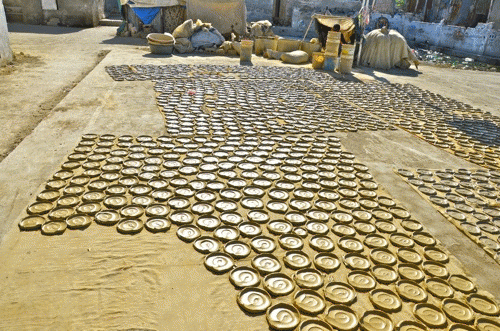
Fort Dimanche was rebuilt by the Marines during the first U.S. occupation of Haiti in 1915. In recent years it was the military headquarters and torture center for the Duvalier regime. This would be a good opportunity for the Marines to make amends.
Meanwhile, the prices of imported seeds, cereals and sugar are expected to stay high until the June harvest. In April of 2008, there were riots over similar conditions.
If the US troops are really positioning for "hurricane relief," there is a $700,000 grant from MINUSTAH (United Nations), earmarked to construct seven hurricane shelters in the Southeast department that could also be used as "training and storage space for food," OCHA says. Why not pitch in and get busy with solid buildings -- not the flimsy, makeshift construction we see everywhere -- before the hurricane season begins?
I am not optimistic. It is beginning to look more and more that what the Obama administration is after in Haiti are valuable resources. There is discussion in the Haitian diaspora that gold, oil and other minerals are waiting for the taking.
Of course, Haiti is only a country of rumors.Authors Website: http://www.georgianne-nienaber.com
Authors Bio:
Georgianne Nienaber is an investigative environmental and political writer. She lives in rural northern Minnesota and South Florida. Her articles have appeared in The Society of Professional Journalists' Online Quill Magazine, the Huffington Post, The Ugandan Independent, Rwanda's New Times, India's TerraGreen, COA News, ZNET, OpEdNews, Glide Magazine, The Journal of the International Primate Protection League, Africa Front, The United Nations Publication, A Civil Society Observer, Bitch Magazine, and Zimbabwe's The Daily Mirror. Her fiction expose of insurance fraud in the horse industry, Horse Sense, was re-released in early 2006. Gorilla Dreams: The Legacy of Dian Fossey was also released in 2006. Nienaber spent much of 2007 doing research in South Africa, Rwanda and the Democratic Republic of Congo. She was in DRC as a MONUC-accredited journalist, and was living in Southern Louisiana investigating hurricane reconstruction and getting to know the people there in 2007. Nienaber is continuing "to explore the magic of the Deep South." She was a member of the Memphis Chapter of the National Academy of Recording Arts and Sciences and is a current member of Investigative Rorters and Editors.