| Back OpEdNews | |||||||
|
Original Content at https://www.opednews.com/articles/Fake-or-Real-Christmas-Tre-by-Reynard-Loki-101129-344.html (Note: You can view every article as one long page if you sign up as an Advocate Member, or higher). |
|||||||
November 30, 2010
Fake or Real Christmas Tree: What Would Jesus Do?
By Reynard Loki
Another Christmas, another mass killing of trees.
::::::::
Here comes Santa Claus -- and the mass killing of trees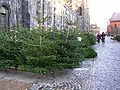
First established in the 16th century by the German theologian and leader of the Protestant Reformation Martin Luther as a Protestant counterpart to the Nativity scene of Roman Catholicism, the tradition of the Christmas tree began with the decorating of evergreen conifers with candles.
Luther wanted the Christmas tree to symbolize the Tree of Life in the Garden of Eden. Ironically, celebrating the holiday means killing millions of live trees.
The longstanding debate over which kind of tree -- real or artificial -- is better for the environment was put to rest in 2008 when Montreal-based sustainable development firm Ellipsos conducted an independent Life Cycle Assessment (LCA) that found that a natural tree will generate 6.8 lbs (3.1 kg) of greenhouse gases whereas the artificial tree will produce 17.8 lbs (8.1) kg per year.
"The results are astonishing," says Ellipsos president and the study co-author Jean-Sébastien Trudel. "Considering that the artificial tree is reusable for many years, one would think that this choice is best since the natural tree requires annual trips to purchase it."
"Although plastic Christmas trees are reusable from year to year, real trees are the more sustainable choice," according to EarthEasy.com. "Plastic trees are made of petroleum products (PVC), and use up resources in both the manufacture and shipping. While artificial trees theoretically last forever, research shows that they are typically discarded when repeated use makes them less attractive. Discarded artificial trees are then sent to landfills, where their plastic content makes them last forever."
"Live trees, on the other hand, are a renewable resource grown on tree farms, that are replanted regularly. They contribute to air quality while growing, and almost ninety percent are recycled into mulch. Live trees are usually locally grown and sold, saving both transportation costs and added air pollution."
But, as Becky Tsang of the San Francisco-based Center for Urban Education About Sustainable Agriculture (CUESA) writes in a recent email, "While the environmental discussion has often focused on plastic vs. real Christmas trees, not all 'real' trees are the same."
"In fact, much like produce, there is a whole range of factors to pay attention to when gauging the sustainability of the choice," says Tsang.
"The majority of Christmas trees are farmed conventionally -- in other words, they are the product of monocropping over vast tracts of land, and they involve fossil fuel-based fertilizers and pesticides, as well as irrigation that causes waste water runoff. A conventional Christmas tree requires around a quarter of an ounce of pesticides to produce; that might not seem like much, but it adds up, and puts Christmas tree farm workers and their families at an elevated risk of pesticide poisoning."
When choosing a live tree, consider a small one that comes in a pot. It can likely live in the pot through several Christmas holidays, and then when it outgrows the pot, it can be replanted outside. And if it can't be replanted, try to have it chipped -- the wood chips can be used in gardens and in the beds of shrubs and trees.
But really, the best option is no tree at all. Leave the tree in nature. When these trees are cut down, they not only lose their much-needed ability to store carbon dioxide, but the carbon dioxide that they were storing is released into the atmosphere, further adding to the concentration of greenhouse gases that cause global warming. And unless the tree is coming from your backyard, chances are it burned gasoline on its trip to your local market.
In the end, less trees means less "ecosystem services." And that means more global warming gases. Less habitat for species. More stormwater runoff. Lower air quality.
Instead, why not try a Christmas cactus? According to Ed Hume, host of the TV show Garderning in America , "It's not unusual for a single plant to be passed down from generation to generation because they're long-lived, rather easy plants to grow."
"People often ask me 'Was Jesus an environmentalist?',"says environmental minister Rev. Sally Bingham in an interview in Soujourner Magazine .
"Jesus identified with marginal people," Bingham says. "And probably today he would identify with endangered species, coral reefs, and forests, because he identified with pain and suffering, and right now creation is in pain and suffering. I would go so far as to say that if Jesus were here, he would not drive an SUV."
He wouldn't buy a Christmas tree either.
Authors Website: http://momentech.blogspot.com
Authors Bio:
Reynard Loki is a New York-based artist, writer and editor. He is the environment and food editor at AlterNet.org, a progressive news website. He is also the co-founder of MomenTech, a New York-based experimental production studio whose projects exploring cosmology, post-humanism, neo-nomadism and futurism have been presented around the world, including Center for Book Arts (New York, NY); DUMBO Arts Festival (Brooklyn, NY) Eastern Bloc Center for New Media and Interdisciplinary Art (Montreal), ITCH Magazine, School of Literature, Language and Media, Wits University (Johannesburg, South Africa); 48 Stunden Neukölln Festival (Berlin); Daet New Media Festival (Philippines); 3///3 (Athens, Greece), Fotanian Open Studio (Hong Kong) and Magmart International Video Festival (Naples). Reynard is a contributing author of Biomes and Ecosystems: An Encyclopedia (Salem Press, 2013). His writing has also appeared in Salon, Truthout, Justmeans, EcoWatch, GreenBiz, Resilience.org and Social Earth.