This perhaps is a path of least resistance, where one can solicit the goings-on of both sides of the fence from one single source rather than discovering the totality for themselves.
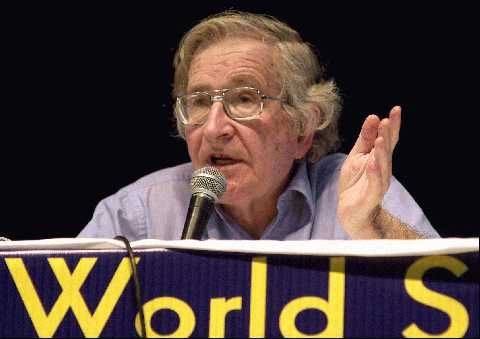
And so, this brings us to one representative of the Left World-View who is extremely intellectual and influential, not only in North America, but the world over. To the many Left thinking/leaning, there are not many of his calibre, and so when issues arise, many may acquiesce first to the words of Noam Chomsky before forming opinion, often, by the way, as a kind of synthesis of Noam's own mind-view.
Whether it's Right or Left or somewhere in the middle or extreme, it is always open, that the opinion offered could be correct, well researched and made with a high degree of objectivity -- maybe. However, it is also very logical that social engineering and the psychologically deeper introspection of why people act the way they do, and the predicting of reaction, surely is studied to a tee. One only has to look at marketing to see how a large degree of people will be swayed, this way or that, thither and yonder give the right programming.
In the case of Noam Chomsky or other people of his like, their command of reasoning, in most cases, is extremely acute and often reliable foundationally. People who reason well may often check their own foundation stones against people like Chomsky to see if they are on the right track, according to their belief structures, and in a high percentage of circumstances they are pleased. Likewise, sociological study and manipulation may predict the outputs based on the very idea that people's reactions are well defined given a life situation, political or otherwise. With that in mind, perhaps if 50 percent of people follow a particular ideological or other trend path, then many others will eventually follow.
This brings us to contradictions. In a recent article on SoTT called "Left-Leaning Despisers of the 9/11 Truth Movement: Do You Really Believe in Miracles?," contradictions were pointed out of many, most holding the ear of a large populace doing their predictable check-up to refine their thinking. However, for some who think to further question, to undertake a type of rational litmus test that looks for error and contradictions, there is a counter if need be.
Humans are well-known to be plagued by error; it is who we are and represents our human nature of fallibility. Most will review and reconfigure their thinking and testing. But as history shows and where certain individuals are concerned, fallibility does not exist or is manipulated away, even in clear view. Sometimes a glimpse is discerned when finer filters are employed that point to inconsistencies, error or plain old conspiracy. When this happens in serious matters, often a tool box of buffers and distractions or even word-psychological-warfare is used to cover or divert in many ways.
This bring us to another SoTT article that is based on the psychological word craft manipulation of the two words "conspiracy theory," "Britain: Terrorists Use 'Conspiracy Theories' in Attempt to Discredit Government and Recruit New Members," which of course can clearly be seen by some as a means to vector people's attention and more importantly, instill new word belief structures.
What does one do when faced with the visible contradictions of a very serious nature such as 9/11, when the mind is confused by a host of opinion makers all vying for your attention? In the case of the Left, one might find entering the stage of opinion someone like Noam Chomsky to sooth-say and put your mind at ease. The Right, too, has their own brand of ideological mentors who help sway, but in the case of the Left, in a full sight of glaring contradictions like 9/11, it seems a masterful stroke of genius might be at play to at least pry that first 50 percent away from thinking, thus putting them back into their proverbial sleep.
In keeping with the first SoTT article above, referencing Noam Chomsky, let us now look at contradictions and the power of persuasion he can yield. First, there are not many instances where disagreement is often made with Chomsky, especially if one cannot think outside of their automation of mind that this influential opinion-maker serves. Many, many hold Noam Chomsky in very high esteem and he more often than not says things that make a heck of a lot of sense. However, in reading the SoTT article by Global Research, someone was remembered who had well prior to 2006 picked up these odd incongruities, and that someone is a well known journalist in his own right by the name of Barrie Zwicker.
In one of his many books, there is one in particular called, Towers of Deception: The Media Cover-up of 911, that caught many people's attention; it must be said that the author obviously holds Noam Chomsky in low esteem, however, it was not so always.
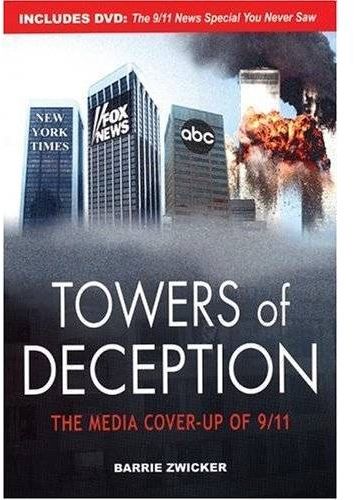
Here is some of Mr. Zwicker's thinking on Noam Chomsky as it relates to the contradictions and word-play of the 9/11 event and other historical tragedies:
On page 177, Zwicker writes:
The formula is clear. We saw it with Peter Scowen in Chapter 1. We see it with the Right Gatekeepers. We'll see it in the next chapter with Noam Chomsky and his fellow Left Gatekeepers. The formula is this: "I need proof but I'm not going to look at the proof." All the rest is from the brain's baloney generator.Looking around today, as before, this looking at Proof or not looking at the Proof, continues. However, again Zwicker, who dedicates a good chapter or more to Chomsky entitled: "The Shame of Noam Chomsky and the Gatekeepers of the Left" - continues starting pages 179 - 184:
"Look, this is just a conspiracy theory." -- Noam Chomsky to author [Zwicker] in conversation, November 14, 2002.Zwicker says:
There's something very strange here. You'd expect George Bush, the most visible face of the American Empire, to employ the intellectually-bankrupt put-down phrase 'conspiracy theory' as an element of his propagandistic rhetoric in defence of the official story of 9/11. On the other hand, about the last person you'd expect use the same phrase the same way for the same purpose would be Noam Chomsky, known for masterful deconstructions of propaganda.Zwicker continues with discussion about how Chomsky defends the use of the term "conspiracy theory" and how it is a tool used in many quoted situations:
Chomsky: For people to call [Chomsky's media analysis] 'conspiracy theory' is part of the effort to prevent an understanding of how the world works, in my view -- conspiracy theory' has become a four letter word: it's something people say when they don't want you to think about what's really going on.Zwicker then continues:
So, when Norm Chomsky repeatedly uses the phrase 'conspiracy theory' to describe questioning of the official story of 9/11, he clearly knows its power and the purpose of its use.Zwicker then writes from page 181 -- 183 a highlighted retrospective piece entitled: "Emotional Considerations Arising from a Study of Chomsky's Work."
This seems to discuss the right vs left perspectives on Chomsky, with the right's "hatched job" in reference to newspaper attacks on Chomsky.
Zwicker writes here:
On the left, the feelings are more complicated. The main emotions are gratitude and admiration -- sometimes to the extent of near idol worship.Zwicker then quotes Daniel Abrahamson:
Noam Chomsky is often hailed as America's premier dissident intellectual, a fearless purveyor of truth, fighting against media propaganda, murderous US foreign policy, and the crimes of profit-hungry transnational corporations. He enjoys a slavish cult-like following from millions [of] leftist students, journalists, and activists worldwide who fawn over his dense books as if they were scriptures. To them, Chomsky is the supreme deity, a priestly master whose logic cannot be questioned.Zwicker then says something interesting of his own thinking:
I was one of his earliest supporters, from the days when most had not heard of him. My admiration knew almost no bounds. I have a stack of his books more than a foot high. I praised him personally and publicly and in my university teaching. I was honoured to interview him for four segments on Vision TV. A friend of mine and I at one time competed to see who could get the larger of letters to the editor published defending Chomsky against the ill-wishers who twisted his words or called him names such as anti American. I assisted in a small way with the filming of Manufacturing Consent.Zwicker discusses emotions, anger and rekindling with friends to study whereby he says:
But I became one of those Left puzzled, even mystified, as a result of Chomsky's insistence for more than 40 years that Lee Harvey Oswald was the lone gunman who killed JFK. This puzzling anomaly took on new significance after 9/11 with Chomsky's opposition to questioning the official 9/11 story -- which questioning he says is a huge mistake for the Left.
As I studied his work even more closely under the intense illumination of 9/11, I became increasingly amazed at the patterns, dealt with in this chapter, that emerged from his body of work. Disbelief turned to shock. I feel I have been duped. I feel embarrassed that mainly I duped myself, that I had been in denial. With these realizations came anger from feeling betrayed by someone I welcomed into my innermost sanctum of trust.
One of my emotional tasks is not to go overboard, like the jilted lover who seeks revenge. Trying to be reasonably...
I also hope you have friends as thoughtful and honest as mine whom to discuss the intellectual, political and emotional aspects of Chomsky and his work. I must say I now find it creepy.Zwicker leaves that and, on page 184, he says of conspiracy theory:
Every person who says or writes "Oh, that's just conspiracy theory" in response to a question or claim about 9/11 should be challenged immediately. The phrase, in that tone, is counterfeit currency. To allow it to stand leaves the person using the phrase the framer of the discourse, and devalues the discourse and the target. It is to expose its illegitimacy and enable more reasoned discussion to proceed.He goes on to describe why in four ways if used pejoratively the phrase fails.
From page 190 - 224, Zwicker sites Chomsky in title after title as an expose of Chomsky's words and actions; too much to start quoting here but will capture a few:
Quote from the Title: "A Below-The-Belt Blow:"
Third, the phrase as a psychological below-the-belt blow. It is justified to describe the term "conspiracy wacko" as a weapon of psychological warfare.Psychologist Floyd Rudmin writes:
The power of this pejorative is that it discounts a theory by attacking the motivation and mental competence of those who advocate the theory. By labelling an explanation of events "conspiracy theory," evidence and argument are dismissed because they come from a mentally or morally deficient personality, not because they have been shown to be incorrect. Calling an explanation of events "conspiracy theory" means, in effect, "We don't like you, and no one should listen to your explanation."Again the Psychologist is quoted in respect to as Zwicker puts it:
"If more people than before suspect high-level conspiracies, Rudmin puts forward an intriguing theory as to why. Conspiracy theorizing arises, he says, when:Zwicker says of the Media and quotes Rudmin again:
a. Significant political or economic events change relationships in society;
b. Contradictions in the explanation of these events are noticed by ordinary citizens;
c. Curiosity and then concern are aroused, and;
d. Further information is sought under the presumption that power is being abused and deception is being deployed.
Conspiracy theory is "deconstructive history" because it is rebellion against official explanation and against orthodox journalism and orthodox history.Zwicker points out some interesting vintage Chomsky where disagreement cannot be made, almost to whatever he speaks of, yet he uses conscious planning and bad planning defaults; not opposites. Zwicker, at one point, says:
But he never -- it should not be controversial to point this out -- connects the jingoistic, racist, fear-based so-called 'War on Terror,' heavily reliant on fear of (Muslim) religious fundamentalism, with the events of 9/11, even though the events of 9/11 are the linchpin for the so called 'war on terror.' In other words, he provides a masterful analysis of the overall problem generically, while avoiding engagement with the specific toxic core that fuels it. And this avoidance is unbending. The contradiction is total.He writes, too:
[...] It took 9/11 to shake me out of my denial. Even then, I see in retrospect, the process was painfully slow. Finally Chomsky's sustained rejection of evidence, his sustained use of the term 'conspiracy theory' to describe the work of those seeking the truth about JFK's assassination (and the other assassinations of the 1960's), and 9/11, and his diminishment of the role of leaders as JFK and his brother, and of Dr. Martin Luther King Jr., became a pattern I could no longer ignore. Writing this book opened my eyes further.These 34 pages are worth reading as Zwicker deconstructs Chomsky's word-play from his own book 9-11, and of his contradictions and statements, Zwicker says:
A deconstruction of Chomsky's output reveals a complex and brilliant interplay. It could be characterized as 'bait-and-switch.' In a bait-and-switch operation, the victim is enticed, then victimized in some way. In this construction, the bait Chomsky offers the Left are his critiques of American foreign policy and propaganda systems of establishment. These are substantial and continuous offerings that earn him admiration and trust among most Left. His 'switch' is to redirect his followers on the Left away from questioning particularly toxic and revealing operations of sinister forces behind the scenes, away from evidence, even, concerning 9/11, and before it the assassinations that decapitated the Left in the 60's.Zwicker talks, too, about the Q-factor of likability, which Chomsky surpasses.
Obscuring that this is his role are propaganda techniques, briefly addressed above, and his personal attractiveness.
What Zwicker describes in his book about Noam Chomsky very thought-provoking and worth the effort to read as a view from the other side of popular opinion. We will end here with a few final and important quoted points.
One of Chomsky's trademark comments is about the power of the people. While appearing to empower dissent, in most of his books and lectures he channels Left energy into a stupor of amazement over past miss-deeds of the Empire and brilliant articulations of the general picture of today's world, which any thinking Leftist can see without the help of Chomsky. His recent comments about Venezuela, again welcome, are nevertheless a case in point.A final note, relating to chapter 5:
Some friends of mine on the Left find it difficult to understand that I am not rejecting Chomsky's massive work of critiquing the American Empire. It's not an either/or proposition. On can (and should) critique the Empire vis a vis East Timor, for instance, and strive to expose some of the most toxic domestic work, such as 9/11. The toxic work powerfully aids and emboldens the Empire in its drive toward ever more militarism, repression at home, and global domination. The events of 9/11 are also the Empire's Achilles Heel, if exposed. The records shows Chomsky strives to prevent the Left from thinking about, let alone exposing, this toxic work. The reality is that Chomsky's ruling out of any investigation into 9/11, which could finally accomplish a real shake-up, is at odds with the implied purpose of his foreign policy critiques - to reveal, oppose and displace the Empire.
Germane here is the truism that 'the most powerful disinformation is 90 percent true.'
If Noam Chomsky had been at the Tattered Cover Bookstore in November 2002, or others like it, his would be the only hand among an audience of 200 Americans to be raised in support of the official story. For shame.The following is 9/10 rule from a work of fiction, Chainfire, by Author Terry Goodkind: "Wizard's Ninth Rule."
A contradiction can not exist in reality. Not in part, nor in whole.
To believe in a contradiction is to abdicate your belief in the existence of the world around you and the nature of the things in it, to instead embrace any random impulse that strikes your fancy - to imagine something is real simply because you wish it were. A thing is what it is, it is itself. There can be no contradictions. Faith is a device of self-delusion, a sleight of hand done with words and emotions founded on any irrational notion that can be dreamed up. Faith is the attempt to coerce truth to surrender to whim. In simple terms, it is trying to breathe life into a lie by trying to outshine reality with the beauty of wishes. Faith is the refuge of fools, the ignorant, and the deluded, not of thinking, rational men.
In reality, contradictions cannot exist. To believe in them you must abandon the most important thing you possess: your rational mind. The wager for such a bargain is your life. In such an exchange, you always lose what you have at stake.