| Back OpEdNews | |||||||
|
Original Content at https://www.opednews.com/articles/A-Hymn-For-Nature-in-Peril-by-Georgianne-Nienabe-100508-603.html (Note: You can view every article as one long page if you sign up as an Advocate Member, or higher). |
|||||||
May 8, 2010
A Hymn For Nature in Peril on the Gulf Coast
By Georgianne Nienaber
This is a very personal attempt by this writer to explain the beauty of this area. I have been around the world and have never experienced a place of such peace, beauty, and rejuvenation. I can understand why the natural world uses the Gulf Coast as a place of refuge.
::::::::
***UPDATE FROM JOINT COAST GUARD AND BP COMMAND***
MOBILE, Ala. - Shoreline assessment teams recovered tar balls Saturday from the beach on Dauphin Island, Ala.
The Oil Spill Crisis Map is showing a pattern of environmental effects that have either impacted or are threatening the Gulf Coast National Seashore. Reports indicate the river of oil is moving closer, and Dauphin Island, Alabama is experiencing odor at this writing. The Audubon Bird Sanctuary is located here. Dauphin Island is the safety net used by birds as they migrate north from South America. It is a sanctuary of rest and rejuvenation for them, or it was so. The Oil Spill Crisis Map compiles and maps eyewitness accounts of the oil's effects in real time," said Anne Rolfes of the Louisiana Bucket Brigade. "This is a tool for all of us to understand theextent of the damage."
The reports are growing daily and offer a real-time look at the impact on the natural world.
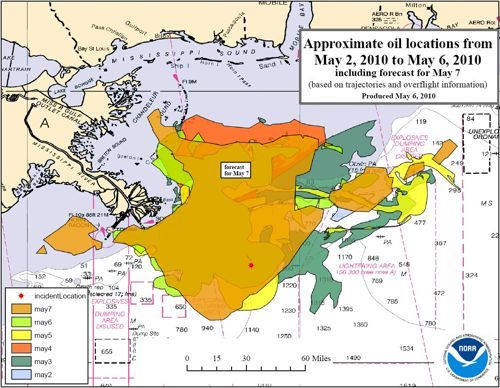
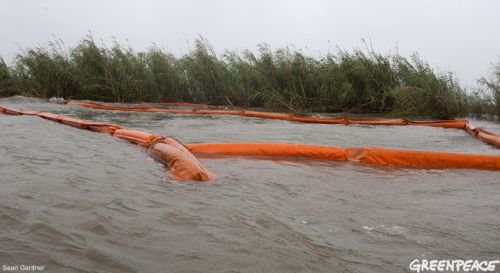
Horn Island and Ships Island, parts of the Gulf Islands National Seashore are also in danger. Horn Island is famous for its long white beaches and is home to alligators, ospreys, pelicans, ducks, tern, herons, and other migratory birds.Reuters News Serviceand the Coast Guard report that booms have been placed on the east and west tips of Horn Island. Whether they will hold is anyone's guess. Booms did not hold off the Birdsfoot Delta in Louisiana's waters.
This is a very personal attempt by this writer to explain the beauty of this area. I have been around the world and have never experienced a place of such peace, beauty, and rejuvenation. I can understand why the natural world uses the Gulf Coast as a place of refuge.
Walter Andersonis name not many know, but he chronicled the beauty and majesty of the Gulf National Seashore, and especiallyHorn Island, like no other.
In 1947, with the understanding of his family, Anderson left his wife and children and embarked on a private and very solitary existence. He lived alone in a cottage on the Shearwater compound, and increased his visits to Horn Island, one of a group of barrier islands along the Mississippi Gulf Coast. He would row the 12 miles in a small skiff, carrying minimal necessities and his art supplies. Anderson spent long periods of time on this uninhabited island over the last 18 years of his life. There he lived primitively, working in the open and sleeping under his boat, sometimes for weeks at a time.He endured extreme weather conditions, from blistering summers to hurricane winds and freezing winters. He painted and drew a multitude of species of island vegetation, animals, birds, and insects, penetrating the wild thickets on hands and knees and lying in lagoons in his search to record his beloved island paradise. Anderson's obsession to "realize" his subjects through his art, to be one with the natural world instead of an intruder, created works that are intense and evocative.
I think the best way to convey the importance of this natural area and what stands to be lost is to offer this video by roots writerCaroline Herring. The disclosure I must offer is that Caroline is a friend of mine. Her tribute to Walter Anderson is also a beautiful hymn to the endangered Gulf Coast.
This is what may be forever damaged. Words alone cannot express how dire the situation is for all life in the Gulf of Mexico.
Authors Website: http://www.georgianne-nienaber.com
Authors Bio:
Georgianne Nienaber is an investigative environmental and political writer. She lives in rural northern Minnesota and South Florida. Her articles have appeared in The Society of Professional Journalists' Online Quill Magazine, the Huffington Post, The Ugandan Independent, Rwanda's New Times, India's TerraGreen, COA News, ZNET, OpEdNews, Glide Magazine, The Journal of the International Primate Protection League, Africa Front, The United Nations Publication, A Civil Society Observer, Bitch Magazine, and Zimbabwe's The Daily Mirror. Her fiction expose of insurance fraud in the horse industry, Horse Sense, was re-released in early 2006. Gorilla Dreams: The Legacy of Dian Fossey was also released in 2006. Nienaber spent much of 2007 doing research in South Africa, Rwanda and the Democratic Republic of Congo. She was in DRC as a MONUC-accredited journalist, and was living in Southern Louisiana investigating hurricane reconstruction and getting to know the people there in 2007. Nienaber is continuing "to explore the magic of the Deep South." She was a member of the Memphis Chapter of the National Academy of Recording Arts and Sciences and is a current member of Investigative Rorters and Editors.