| Back OpEdNews | |||||||
|
Original Content at https://www.opednews.com/articles/Part-Two--Ann-Jones-Auth-by-Joan-Brunwasser-091203-379.html (Note: You can view every article as one long page if you sign up as an Advocate Member, or higher). |
|||||||
December 3, 2009
Part Two: Ann Jones, Author of "Kabul in Winter," Talks with OpEdNews
By Joan Brunwasser
The men who staff the militaristic conservative think tanks in Washingtonâ??the so called expertsâ??might as well be playing video games for all they know or care about Afghan women.From a woman's point of view,our friends & our enemies in Afghanistan are the same kind of guys;and as long as these Islamist fundamentalists are in powerâ??whether Taliban or mujahidinâ??women's rights will be a joke and women's lives in jeopardy.
::::::::
Welcome back for the conclusion of my interview with writer Ann Jones. It didn't seem as if many of the officials on the ground described in your book had a deep understanding of the Afghan culture and situation. If that is true,what does that mean in terms of efficiency of delivering aid and the future for our involvement over there, ostensibly to be helping them?
~
I don't think that â??helping themâ? was
ever an American objective, and it certainly isn't now. â??Delivering aid,â?
as you put it, was part of State Department strategy under the Bush
administration, designed to serve US (not Afghan) national interests. In any
aid organization, it's always difficult to find people steeped in the language
and culture and willing to stay long enough to see projects through, but as a
minimum requirement they should be good at what they're hired to do.
~
Yet under Bush, we delivered (never competently) what we wanted to giveâ??that is, whatever Bush/Cheney corporate friends wanted to be overpaid to deliver. Things like shoddy roads at a million bucks per mile, exorbitantly expensive schools with collapsing roofs, private bodyguards for the warlords we'd put in power.
~
USAID was established by JFK as a kind
of professional peace corps, staffed with specialistsâ??teachers, hydrologists,
public health administrators, engineers, agriculturalistsâ??capable of working
with people at the grass roots on projects they initiated.
~
Over the years, it dwindled into a blunt instrument of foreign policy, and under Bush it became a contracting shop, handing over ridiculous sums to for-profit private contractors who share the wealth in kickbacks to their favorite congresspeople. (When Afghans do things like this we call it â??corruption,â? and just the other day President Karzai responded to charges of corruption by saying that America must share the blame.)
~
President Obama boldly announced months
ago his intention to send civilians to Afghanistan to assist with development
aid; but soon after, he acknowledged that civilians, being hard to find in
their unadulterated state, would be drawn from the military instead.
~
During the entire American occupation of Afghanistan, the percentage of our â??foreign aidâ? going into the military budget has been variously estimated at 75-90 percent. The practice seems likely to continue. Which means that we actually give very little aid to the Afghan government, or to the Afghan people. And that failure helps explain why so many Afghans see the American presence only as an army of occupation.
~
I've proposed an alternative: that we give grants to Afghan-Americans and other hyphenated Afghans of the diaspora to return to their ancestral villages for a few months and spend the money on projects to benefit the communities. Afghan-Americans already do more for their homeland than American aid does. Why not subsidize them?
~

~
What a creative yet simple idea. I wonder why nobody in the upper echelons came up with it. Can you talk about whether or not women are better off since the American invasion?
~
Well, they are and they're not.
After what George W. Bush called the â??liberationâ? of Afghan women, women in the
cities were able to leave their homes unescorted, and many women in Kabul and a
few other cities went back to work. Women also seemed to make promising
gains on paper: a new constitution spoke of â??equal rights and duties,â? and
Afghanistan signed the major international human rights agreements, including
CEDAW, the [UN] convention to eliminate all forms of discrimination against
women. Thanks to a quota system, women were elected (in 2005) to about 25
percent of the seats in the new parliament.
~
But outside the cities, life
for the vast majority of Afghan women didn't change at all. And while
Bush spoke of liberation, no one in the administration seemed to notice that
the Afghan president we installed kept his own wife, a doctor with much needed
skills, at home.
~
That should have been the tip off to the true attitude toward women of the Karzai government, which consists principally of former mujahidin, Islamist fundamentalists very much like the Taliban, and in some cases, one and the same. Karzai also put the judiciary in the hands of fundamentalist mullahs, effectively denying women legal recourse to claim their theoretical â??rightsâ? or defend themselves against charges of adultery when they'd been raped or run away from home to escape abuse.
~
Many international aid agencies worked
steadily at literacy, education, and health projects that started to make life
a little better for ordinary Afghans; but in 2005, the year that saw the first
in a continuing series of assassinations of women in public life, the brief
progress of women in the cities went into reverse.
~
And as warfare spread across the countryside, the lives of rural women and their families became much more difficult. Whenever foreign troops appear, men lock up women just as the Taliban did. Thousands of civilians have been killed, many by American airstrikes, and most of the casualties are women and children. At this time at least a quarter of a million people have been displaced by the fighting; in the makeshift refugee camps on the outskirts of Kabul, women and children predominate.
~
Recently President Karzai put into effect a Shia Personal Status Law worthy of the Taliban; it authorizes men to deny food to wives who fail to provide sex on demand, gives men complete control of the movements of all their female relatives, and much more you don't want to hear. The powerful Wahhabi fundamentalists who dominate parliament so intimidate the women parliamentarians that they agree to such things. Many have been threatened with death or charges of blasphemy, an offense punishable by execution. Women journalists too have been assassinated; those still working dare not speak of women's rights. The women I've worked with for years in humanitarian organizations now fear for their lives.
~
This is the situation and the
government our soldiersâ??women and men alikeâ??are required to fight and die
for. I've worked with Afghan women for years and seen their courage in the
face of terrible oppression, so I'm infuriated by the cynical argument of hawks
who claim we need more troops in Afghanistan to protect the great progress of
women. Even some women's organizations, who should know better, fall for
this line.
~
And the men who staff the militaristic conservative think tanks in Washingtonâ??the so called expertsâ??might as well be playing video games for all they know or care about Afghan women. From a woman's point of view, our friends and our enemies in Afghanistan are the same kind of guys; and as long as these Islamist fundamentalists are in powerâ??whether Taliban or mujahidinâ??women's rights will be a joke and women's lives in jeopardy.
~
An American military officer once
advised me that I shouldn't bother with â??the trivial matter of women's
fate.â? But I think that advice goes straight to the heart of what's wrong
with American foreign policy. We, or rather our policy makers, think of
war as serious business for big boys; women's issues are just an add-on we may get
to by and by.
~
But in fact â??women's issuesâ? are the central concerns of
civil society: clean water, sanitation, food supply, shelter, education, health
care, good governance, justice. Our policy makers put all these things on
hold and busy their minds with more important stuff like troop strength, arms,
and exit ramps. And all of our boy leaders are seduced by the heady
business of playing commander in chief.
~
Obama is only the latest and most sad. Is it any wonder that our country is always and ever at war somewhere on the planet, while a quarter of our American kids need food stamps to survive? The skewed priorities of our own government, in thrall to the military-industrial-congressional complex, have militarized not only our foreign policy but our domestic life as well.

~
What are you doing now?
~
I work with the UN as a gender advisor, and I continue to work with Afghan women every chance I get. I'll go back to Kabul again soon, but right now I'm wrapping up a new book about the impact of war on women around the world. It's based largely on a project I did in 2007-08 for the International Rescue Committee and UNHCR [The UN Refugee Agency]. Working in post conflict zones in Africa, Asia, and the Middle East, I gave digital cameras to women and watched in amazement as they documented their lives and spoke up for change. The book is called War Is Not Over When It's Over. It will be out next fall.
~
Is there anything you'd like to add, Ann?
~
Just my thanks for your concern and for letting me sound off. You know, Joan, I've been surprised at the number of men, including military men, who write to me to support my conclusions. I think there are a great many Americans of all political persuasions who would be happy to see the end of macho-man politics and foreign policy. War and war-contracting have become ways of transferring money from the public treasury to the pockets of the already rich. It's time to change that.
~
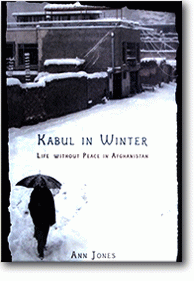
Kabul in
Winter should be required reading for
everyone from our highest public officials down to us lowly taxpayers.
Read it and you will radically increase your understanding of Afghanistan, past and present. That is particularly timely in light of Pres. Obama's speech on Tuesday
evening. Thank you so much for speaking with me, Ann. Good luck to you.
***
Part
one of my interview with Ann
Ann's website
Ann's post-speech analysis for NPR, December 1, 2009: Obama's Still Wrong, But 'Winning' Is Everything. On Commentary: 'Obama's Wrong: It's Time To Walk Away From War'
Observers:
Plight Of Afghan Women Often Overlooked, Interview with NPR, November 3,
2009
Authors Website: http://www.opednews.com/author/author79.html
Authors Bio:
Joan Brunwasser is a co-founder of Citizens for Election Reform (CER) which since 2005 existed for the sole purpose of raising the public awareness of the critical need for election reform. Our goal: to restore fair, accurate, transparent, secure elections where votes are cast in private and counted in public. Because the problems with electronic (computerized) voting systems include a lack of transparency and the ability to accurately check and authenticate the vote cast, these systems can alter election results and therefore are simply antithetical to democratic principles and functioning.
Since the pivotal 2004 Presidential election, Joan has come to see the connection between a broken election system, a dysfunctional, corporate media and a total lack of campaign finance reform. This has led her to enlarge the parameters of her writing to include interviews with whistle-blowers and articulate others who give a view quite different from that presented by the mainstream media. She also turns the spotlight on activists and ordinary folks who are striving to make a difference, to clean up and improve their corner of the world. By focusing on these intrepid individuals, she gives hope and inspiration to those who might otherwise be turned off and alienated. She also interviews people in the arts in all their variations - authors, journalists, filmmakers, actors, playwrights, and artists. Why? The bottom line: without art and inspiration, we lose one of the best parts of ourselves. And we're all in this together. If Joan can keep even one of her fellow citizens going another day, she considers her job well done.
When Joan hit one million page views, OEN Managing Editor, Meryl Ann Butler interviewed her, turning interviewer briefly into interviewee. Read the interview here.
While the news is often quite depressing, Joan nevertheless strives to maintain her mantra: "Grab life now in an exuberant embrace!"
Joan has been Election Integrity Editor for OpEdNews since December, 2005. Her articles also appear at Huffington Post, RepublicMedia.TV and Scoop.co.nz.