| Back OpEdNews | |||||||
|
Original Content at https://www.opednews.com/articles/Part-Two-Talking-with-Rem-by-Joan-Brunwasser-091026-948.html (Note: You can view every article as one long page if you sign up as an Advocate Member, or higher). |
|||||||
October 26, 2009
Part Two: Talking with Remote Area Medical Founder, Stan Brock
By Joan Brunwasser
But you know the World Health Organization rates 190 countries in the way they're able to able to deliver care to their citizens. We are rated number 37... Remote Area Medical policy,that we adhere to strictly, is if you're wiling to stand in line, on a first-come, first-served basis, we don't care where you're from. We're not going to ask you who you are. We just ask, "Where does it hurt? "
::::::::
Welcome back for the second segment of my interview with Remote Area Medical founder Stan Brock. We were talking about how Tennessee was able to change its laws to make it easier to bring in volunteers from out of state. How do you use the success in Tennessee as a template for other states? And, while you're at it, please tell us more about what you see as you cross the country.
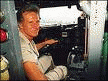
We, and me in particular as the chairman and founder of this organization, are not taking any political sides in this debate whatsoever. This terrible situation with health care in this country that is so unfair to so many millions of people is for the government to resolve. But you see 1,000 people standing in line in the wind and the rain - because they line up all night, a lot of them in wheelchairs, and people carrying oxygen bottles, with nasal cannula. Even though we only see a few children - about 6%, because children are covered and can get the care they need, in most cases - we see some terrible sights.
And it's
been reported in the New York Times
and the Washington Post and other
major newspapers around the world. In fact, when you look at the photographs,
it's hard to believe that this is America. You see people who are willing to
line up for 15 hours, all night, just to get the care that they simply cannot
afford. And they're now traveling long distances. We recently held a
clinic in Kentucky and there were some people there who had traveled 400 miles,
from up in Indiana somewhere.
And we've had patients come all the way from
Wisconsin, Florida, and Maryland. They make that journey by vehicle and some of
them even get an airline ticket; if they have serious problems like multiple
dental extractions that need to be done,sometimes full mouth extractions,
where we have to remove all 32 teeth because they're totally destroyed from
lack of care over many, many years. They've been to a dentist and the
dentist said "Well, that looks like about $5,000 worth of work you've got
there." So we're seeing more and more people like that. And of course,
what we do for them is absolutely free. We just do the best we can for as many
as we can. But we can't see all of them, so we end up turning away large
numbers.
Do you get a lot of press coverage every
time your expedition shows up?
Last year, CBS News 60 Minutes
covered one of our expeditions here in Tennessee with what I thought was a most
compassionate and very, very well-produced thirteen minutes. After that, there
was, and continues to be, a tremendous influx of media not only the local media
and the major networks, in the case of Los Angeles, which became a high profile
event as far as the press was concerned. But they're coming from all over the
world.
The Germans must have been here a dozen times in the last year.
Every magazine, it seems, and every network in Germany, the same in France,
dozens of French reporters have been here. The Japanese have been here several
times. The Australians several times, the British, the Poles, the Finns, the
Italians, the Swiss, they're all over this question because they're all asking
the same thing. Why is this necessary in the world's richest country? And when
you see the photographs that they produce in German magazines, and French
magazines - and they send us a copy usually - it just looks like the Third
World. And it just floors them to see this being the situation here, in the
richest country in the world.
But you know the World Health Organization rates 190 countries in the way
they're able to able to deliver care to their citizens. We are rated number 37.
Number one in the world, according to the World Health Organization, is France.
Number two is Italy. The very bottom of the list, #190, is Burma. So it
starts to look as though, if you're expecting to have some devastating problem,
maybe you ought to have it happen while you're in France.
I'm sure you must get more requests than
you could possibly fill. How do you decide where to go?
Well, a lot of that decision, of course,is based on where we can
recruit enough people outside of Tennessee, given the restrictions of those
laws that we've talking about. Before 60 Minutes, the only people who
knew what we were doing were the poor. But now the whole world seems to know
about it. If you Google "Remote Area Medical RAM," you'll get
100,000 hits from all of these news reports, etc. But we've had requests from
just-stick-a-pin-in-the-map; it doesn't matter. We've had requests from Dallas,
places in Florida, Detroit, New York City, Seattle, San Francisco, New Mexico,
all over the place.
Is that because the emphasis is no longer
on strictly rural, because you've started moving into cities and more populated
areas?
We're obviously on the verge of that. We've done a lot of these things in small
townships. You know Knoxville, Tennessee, for example is 3-400,000 people,
maybe a million people within a 50-mile radius, and places of that size. We've
done a lot in those size communities. But most of it is in the small rural
areas, places like southeast Kentucky and southwest Virginia. But, yeah,
we've been to New Orleans, not only during the hurricane, but a year later and
two years after. And seen
thousands of people in the space of a week as we did in Los Angeles.
And after
Los Angeles in August, we loaded up the stuff and went up to the Indian
reservation in Fort Duchesne, Utah, and worked with the Indian Health Service
for four or five days. But there, of course, we're restricted to see just
Native Americans because we're under the jurisdiction of the federal government
and, to an extent, the state of Utah, and we were not allowed to treat the
general population.
Who shows up when you come to town?
Our policy, that we adhere to strictly, is if you're wiling to stand in line, on a first-come, first-served basis, we don't care where you're from. We're not going to ask you who you are. We just ask, "Where does it hurt? " We just take basic information in the event that some follow-up is needed. And of course, we need to know if you're on medication X,Y, or Z so we don't do something that's counter-indicated. But we don't ask any questions.
And
when a family of five people come up to the registration who've waited all
night and they're obviously from somewhere south of the border, and perhaps
they have two or three little kids holding worn out hand me down teddy bears,
we're not about to say "We're not going to treat you because you're not
supposed to be here." So, we just treat everybody.
But when we're on a Native American reservation and working under the auspices of the Indian Health Service, we are only allowed to provide care to Native Americans. Because if we treat people who are not Native Americans, then you're in someone else's state and you better have people who are licensed in that state. Whereas when we go to the IHS we can get a waiver by filling out some forms to bring in practitioners from other parts of the country.
So you have more flexibility in
those situations. That's good.
Yes, to that extent. It used to be very onerous years ago with many, many
sheets of paper that had to be filled out in order to volunteer as a dentist or
a medical doctor at an Indian reservation in this country. To the extent that
it was very hard to get people to go through all that drama and then it took
about two-month to have a background check.
But now, I must say, the facility in Utah, thanks to very helpful people there, the Indian Health Service staff, Larry Zubel, who is the credentialing officer there, it was a minimum of paperwork there. They went to the national practitioner database on the internet, I'm sure, and within moments you could tell if you were getting someone with a little bit of problem in their medical history background. So, I'm hoping that now as we're starting to expand into other Native American reservations where we've had invitations, that the credentialing part will be as simple as it was in Fort Duchesne, Utah.
That's encouraging. Let's take a break, Stan. When we return, you can tell us about what preparation for a typical expedition looks like, how you support your project and why you haven't done an expedition in Washington, DC yet.
***
Part one of my interview with Stan
Authors Website: http://www.opednews.com/author/author79.htmlAuthors Bio:
Joan Brunwasser is a co-founder of Citizens for Election Reform (CER) which since 2005 existed for the sole purpose of raising the public awareness of the critical need for election reform. Our goal: to restore fair, accurate, transparent, secure elections where votes are cast in private and counted in public. Because the problems with electronic (computerized) voting systems include a lack of transparency and the ability to accurately check and authenticate the vote cast, these systems can alter election results and therefore are simply antithetical to democratic principles and functioning.
Since the pivotal 2004 Presidential election, Joan has come to see the connection between a broken election system, a dysfunctional, corporate media and a total lack of campaign finance reform. This has led her to enlarge the parameters of her writing to include interviews with whistle-blowers and articulate others who give a view quite different from that presented by the mainstream media. She also turns the spotlight on activists and ordinary folks who are striving to make a difference, to clean up and improve their corner of the world. By focusing on these intrepid individuals, she gives hope and inspiration to those who might otherwise be turned off and alienated. She also interviews people in the arts in all their variations - authors, journalists, filmmakers, actors, playwrights, and artists. Why? The bottom line: without art and inspiration, we lose one of the best parts of ourselves. And we're all in this together. If Joan can keep even one of her fellow citizens going another day, she considers her job well done.
When Joan hit one million page views, OEN Managing Editor, Meryl Ann Butler interviewed her, turning interviewer briefly into interviewee. Read the interview here.
While the news is often quite depressing, Joan nevertheless strives to maintain her mantra: "Grab life now in an exuberant embrace!"
Joan has been Election Integrity Editor for OpEdNews since December, 2005. Her articles also appear at Huffington Post, RepublicMedia.TV and Scoop.co.nz.