






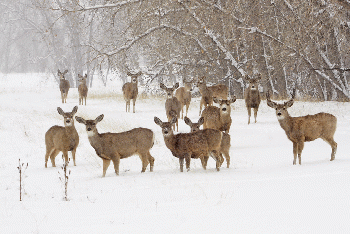
Thinking more carefully about these examples one might notice that they do not involve actual elections as we know them. There are important fundamental differences, more important the absence of computers or paper ballots. Antelope do not form political parties with for example one party having an ideology of always wanting to head south. But the more important is that these animal examples actually resemble negotiations more than they do than elections. All of the voters can watch one another and judge how opinions are running and they can then adjust their own vote accordingly; in a PV election a voter casts a ballot and there is no opportunity for adjusting votes to reach consensus.
In this connection it is interesting to also consider something that is right about instant runoff voting (IRV). Although with IRV a ballot is turned in and the voter has no opportunity to go back and revise it, the voter is offered the next best thing, namely to indicate on the ballot how the voter would like to alter her ballot if given the opportunity to change it as candidates are eliminated.
A two-round voting system is used in some places to let only the top two candidates in the first round run in the final round. It would be interesting to find out how often the second-place candidate becomes the winner in the second round; with PV used in the first round it would likely be often but that would probably change according to the quality of the voting system that is used in the first round. I suspect that if balanced approval voting were used for the first round then the second round would not often change the outcome.
Two-round voting would be another way that is used to introduce at least some of the advantage that the birds and antelopes have over our elections using PV. But the motivation surely has more to do with wanting the winner to get the endorsement of a majority of voters. Though technically true, this is a dubious claim; many and possibly most voters probably prefer candidates not on the final ballot. In this respect, this is little different from having a runoff election with only one candidate on the ballot. Just as with having the top two candidates, the outcome would not really fool anyone but it would formally justify a talking point that, not only was there a majority vote but in fact there was unanimous support.