






Practically speaking, a new government-sponsored persecution of Catholics is breaking out in our midst.
I'm not exaggerating. I mean if we consider attacks on predominantly Muslim countries as veiled attacks on Islam, we should also consider attacks on predominantly Catholic countries like Mexico and El Salvador as attacks on Catholicism.
Such antagonism has long and bloody precedent. In fact, all during the 1980s the United States fought what Noam Chomsky calls "the first religious war of the 21st century. On Chomsky's analysis, it raged against the Catholic Church in Latin America whose bishops had together dared to affirm a "preferential option for the poor" as their official position. The conflict created chaos particularly in Central America. It took the lives of hundreds of thousands of Latin American Catholics. Today its aftermath remains a principal cause behind the stream of refugees entering the U.S. through Mexico.
Donald Trump's policies against refugees represents an extension of that 1980s religious war. In its current form, it vilifies and excludes Catholics as devoid of the moral standards the Church prides itself on teaching.
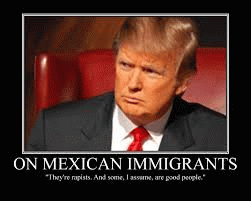
Think about it. Trump has identified Mexicans and Central American refugees as morally deficient. The president said:
"When Mexico sends its people, they're not sending their best. . . They're sending people that have lots of problems, and they're bringing those problems with us. They're bringing drugs. They're bringing crime. They're rapists. And some, I assume, are good people."
Here Mr. Trump identifies good Mexican Catholics among us as the exception, not the rule. The vast majority, he claims, are drug dealers, criminals, and rapists.
However, my own specifically Catholic experience gives the lie to his words. He's demonizing my fellow parishioners -- people I consider my brothers and sisters in Christ. I know them by name: Amelia, Carlos, Ana, Isidro, Graciela, Ramon. . . Criminals? Rapists? Drug dealers?
There are at least 100 such people in my parish church of 200 families. And that doesn't even count the DACA students in our local Berea College. Under Trump, all of these people and their families stand accused not only by the president, but by those he emboldens to harass them. In other words, my fellow Catholics are in danger, so are their sources of income, their health and well-being.
Recently after church, I spoke with some of the endangered. They all agreed; they feel threatened and quite frightened. Moreover, they would appreciate more evident solidarity and support from Anglo parishioners who, in the case of my parish, usually attend a separate Mass.
How then might I respond to the plight of their Hispanic brothers and sisters in Christ? Here's what I'm thinking: I might
- Clearly identify in my own mind President Trump's policies as anti-Catholic and specifically threatening to my fellow parishioners.
- Lobby my senators and congressional representative to vote against Mr. Trump's immigration policies.
- Use the term "anti-Catholic" in my phone messages to those politicians.
- Try to persuade the parish council in my local church to declare our parish a sanctuary for the refugees and immigrants among us.
- Begin participating in the Sunday "Hispanic Mass" instead of the earlier mostly Anglo ceremony.
I suspect that actions like those, if adopted more generally, would start parish-wide conversations about Mr. Trump's policies that affect my brothers and sisters. They might raise the awareness of conservative parishioners. Such actions hold the promise of mobilizing many against the Trump administration's fearful xenophobic juggernaut that, as I've said, is in practice quite anti-Catholic.
 1
 1
 1