






Development justice, where no one is left behind, is vital for a better world for everyone
(Image by CNS) Details DMCA
The pandemic, COVID-19 does not discriminate between people based on
their class, gender, or ethnicity. However, it has inevitably exposed the
socio-economic disparities existing in our society. It demonstrates the power
of privilege to different sections of society. The most vulnerable will bear
the maximum brunt of it. People with low socio-economic backgrounds are
unlikely to have the requisite financial capital and/or physical capacity to
make self-distancing and self-isolation a viable option in the light of their
everyday lives. The pandemic, if not managed correctly, would have far-reaching
economic and social consequences, which would widen existing inequalities and
further hobble the world's efforts to achieve the Sustainable Development Goals
(SDGs). With human rights out of the window and millions
affected without food, water and shelter, we have to move fast in an
attempt to provide justice to all.
In just a few months, everyone's horizon has shrunk and shortened. This is
definitely not ideal for achieving the SDGs, because, even before this
pandemic, the world was lagging behind in its attempts to achieve them. And now
the present crisis has simply worsened the situation.
The World Health Organization's Director-General, Dr Tedros Adhanom
Ghebreyesus, describes COVID-19 as: "The
defining global health crisis of our time".
The Secretary General of the United Nations (UN) António Guterres said that "When we get past this
crisis, which we will, we will face a choice. We can go back to the world as it
was before or deal decisively with those issues that make us all unnecessarily
vulnerable to crises."
A recent study conducted by the Asian Development Bank shows that the
epidemic could lead to a net loss of US$ 16-43 billion in the Asia-Pacific
Region, excluding China. The current focus of governments must be to look
after the needs of its citizens, especially the poor and the vulnerable.
However, the governments must not lose sight of the SDGs.
The pandemic has caused deaths of roughly 4,19,090 people worldwide as of June
11, 2020. Despite severe measures like lockdowns and quarantines, human life
has taken a beating. Though these measures were necessary, they have had a
colossal impact on SDG-8 (decent work and economic growth) and SDG-9 (industry,
innovation, and infrastructure). With
migrant workers left stranded on stree ts, and daily wage earners left with
no money and food, these two goals are far out of reach.
Access to health services in some countries, including essential primary health
care, is contingent upon insurance and user"pay systems that automatically make
these services inaccessible to the people most at"risk. With the private sector
gaining control over medical services in most countries, the
poor and unprivileged are out of the loop more often than not, cocking a
snook at SDG-3 (Good Health and Wellbeing).
With every country scrambling for disposable gloves and masks, the waste
generated due to their excessive use would harm the
environment negatively and increase carbon emissions which adversely
affects SDG-12 (Responsible Consumption and Production).
Sanitation,
frequent hand wash, high consumptions of detergents and disinfectants may
affect the quality and quantity of water. Moreover, the effluents can cause
water pollution. This has a detrimental effect on SDG-6 (Clean Water and
Sanitation) and SDG-15 (Life on Land).
Additionally,
several schools have shut down due to social distancing norms which hit
SDG-4 (Quality Education) quite massively. Moreover, many schools, both public
and private, have opted for online learning using platforms like ZOOM and
YouTube. However, the
authorities fail to recognise that roughly half of the world's population is
without access to the internet, and this creates a larger divide by leaving
behind the poor and underprivileged students.
With businesses and offices
being forced to shut down, the economies have come to a halt. The service
sector has moved from physical workstations to digital workspaces, thus,
increasing the reliance on digital connectivity by tenfold says, Dr Nilanjan
Ghosh, Director of Observer Research Foundation, Kolkata. He says that a
large portion of the service sector in developing countries comprises casual
labourers who are not featured in the digital space. It will not be an easy
task to accommodate them in the digital atmosphere due to a variety of reasons.
Such inequality in opportunities and incorporation in the digital world would
obstruct the progress of SDGs 1, 2, and 10 regarding poverty, hunger, and
inequality.
He expressed concerns about the progress of SDG-16, which talks of peace,
justice, and strong institutions. The pandemic has led to a distorted sense of
justice wherein the Supreme Court of India initially ignored the plight of its
citizens. But due to concerted efforts of several human rights activists,
including lawyers, it has finally come to their rescue. Justice AP Shah told in
an interview with The Wire that he was "disappointed"
by the functioning of the Supreme Court of India. It is imperative for
sustainable development "where no one is left behind" that justice
becomes a norm for everyone, especially for the most marginalised and
underprivileged.
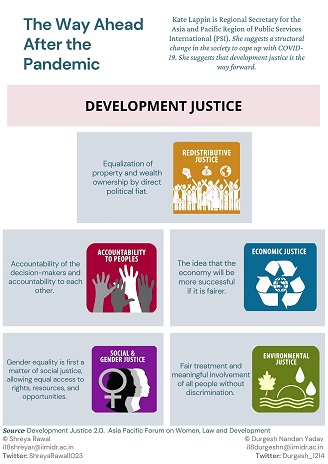
Kate Lappin, Regional Secretary for the Asia and Pacific Region at
Public Services International (PSI), talked about how
COVID-19 will have a detrimental effect on the hopes of nations for sustainable
growth. However, she professed that the SDGs can be a useful tool to combat its
destructive impacts both now and in the future. She believed that it would help
us to better plan integrated responses to make the most of the synergies
between the different objectives.
never waste a good crisis
(Note: You can view every article as one long page if you sign up as an Advocate Member, or higher).