





Reprinted from Dispatches From The Edge
Back in August, Abbas Habib, coordinator of the Council of Syrian Tribes, met with Russian Deputy Foreign Minister Mikhail Bogdanov to explore the possibility of a "preliminary conference" of the antagonists, first in Moscow, then in Syria. In November, the Russians also met with Qadri Jamil, a leader of the Popular Front for Change and Liberation, an in-house opposition party that functions inside Syria. The outcome of the November talks was an agreement to "promote the launch of an inclusive intra-Syrian negotiation process on the basis of the Geneva communique of June 30, 2012."
The 2012 Geneva agreement called for "the establishment of a transitional governing body, which would include members of the present government and the opposition, an inclusive National Dialogue process, and a review of the constitutional order and the legal system." Implementation dissolved in the face of intransigence on all sides, and stepped up support for the armed opposition by Saudi Arabia and the other Persian Gulf monarchies, plus the U.S., Turkey, and France.
But two more years of brutal warfare has accomplished very little except generating millions of refugees, close to 200,000 deaths, and widening instability in neighboring countries. The Syrian government of Bashar al-Assad admits there is no military solution to the war, and the U.S. has backed away from its "Assad must go" demand. According to David Harland of the Center for Humanitarian Dialogue, most of the rebels and their backers have also concluded that "Assad's departure cannot be a precondition for talks."
In essence, most of the players fear the Islamic State of Syria and Iraq (ISIS) more than they do of the repressive Assad regime. As Harland puts it, "Better to have a regime and a state than not have a state."
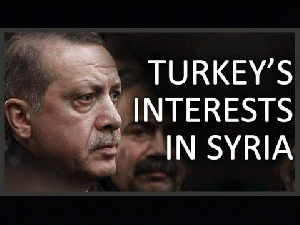
But that approach runs counter to Turkey's strategy, which has as its centerpiece the ouster of Assad. Indeed, the government of President Recep Tayyip Erdogan argues that the threat of the ISIS is secondary to overthrowing the Damascus government, and that once Assad is gone, the Islamic extremists will disappear.
That analysis -- shared by virtually no on else in the region -- is why the Turks have locked horns with the U.S. by resisting to supporting the Kurds fighting to hold the Syrian border town of Kobani against the ISIS. Most of the Kurds involved in that battle are members of the Syrian Kurdish Democratic Party (PYD), an offshoot of Turkey's long-time nemesis, the Kurdistan Workers Party (PKK). As Erdogan told reporters, "The PKK and ISIS are the same for Turkey. It is wrong to view them differently. We need to deal with them jointly."
But aside from the Syrian Army, the PYD is the only serious military force resisting the ISIS, a fact that even the U.S. has come around to recognizing. Initially reluctant to support a group tied to the PKK -- officially designated a "terrorist organization by the U.S. and the European Union (EU) -- the Americans have done a 180 degree turn, supplying the PYD with arms, ammunition and food.
(Note: You can view every article as one long page if you sign up as an Advocate Member, or higher).
 1
1
 1
1
 1
1






