



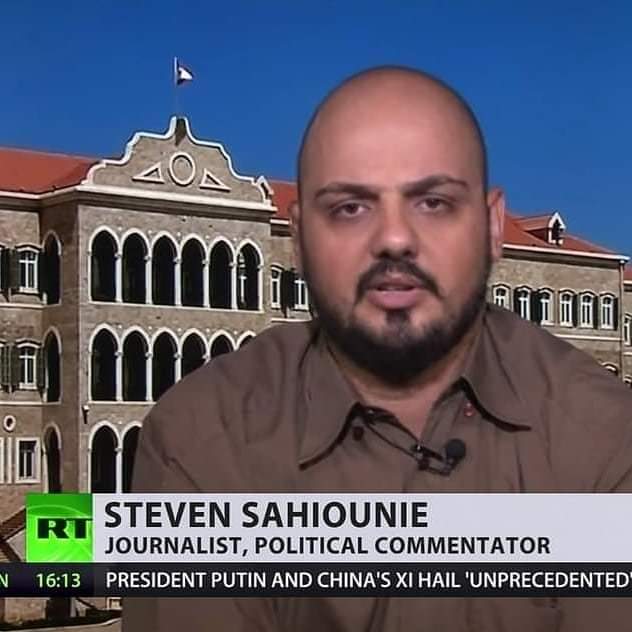


Steven Sahiounie, journalist and political commentator
The renewed escalation between Ansar Allah (the Houthis) and the Kingdom of Saudi Arabia, following years of calm, has set the Middle East ablaze and plunged the region into an unprecedented and dangerous escalation, particularly as the war involving the US-Israel war on Iran continues.
Amid the military silence of Riyadh's allies and Yemen's escalation through its control of the Bab al-Mandeb Strait, Saudi Arabia finds itself standing alone in this confrontation. Devastating strikes have had a significant impact not only on the Saudi economy but also on global energy prices
Journalist Steven Sahiounie interviewed Suat Delgen, a former Turkish naval officer, who focuses on the defense industry and foreign policy issues. He has extensive knowledge of naval warfare systems, NATO, EU security and defense policy, maritime security, new technologies, and Western Asia.
#1. Steven Sahiounie (SS): For many years, the Saudi-Ansar Allah front remained relatively calm. What, in your assessment, has triggered the renewed escalation at this particular moment? What are the main political, military, and regional factors behind the reopening of this front, and who could potentially benefit from the escalation?
Suat Delgen (SD): My assessment is that the Houthis see an opportunity to strengthen their position inside Yemen and force Saudi Arabia to negotiate on more favorable terms. The relative calm never resolved the underlying conflict. The legacy of the Saudi-led blockade, restrictions on access and unresolved political and economic disputes continued to shape the relationship.
The war involving Iran and the United States has changed the regional setting. Tehran has sought to spread the costs of the confrontation across the region, increasing pressure on Saudi Arabia and the other Gulf states. With Iranian support, the Houthis have been able to exploit that situation while pursuing their own territorial and political objectives.
I see their advance along Yemen's Red Sea coast and towards strategically important islands as part of an effort to acquire greater influence over Bab al-Mandab. They want a bargaining instrument similar to the one Iran possesses at Hormuz. The ability to threaten Saudi shipping gives them a means of imposing costs on Riyadh and demanding concessions.
They do not need to exercise complete control over the strait to achieve this. If they can make passage sufficiently dangerous or expensive, they can influence commercial decisions and put pressure on the Saudi leadership.
The Houthis are the most immediate potential beneficiaries. They could emerge with more territory and a stronger negotiating position. Iran also benefits when its adversaries have to divide their attention and resources across several fronts. That does not mean every Houthi decision is dictated by Tehran; their interests overlap, but the Houthis have their own ambitions in Yemen.
There could also be an unintended consequence. If Riyadh concludes that its current security partnerships cannot provide adequate protection, it may become more willing to explore closer cooperation with Israel. That would complicate Iran's calculation of what it has gained from this escalation.
#2. SS: Saudi Arabia recently signed the Mecca Agreement with Turkiye and Pakistan. However, despite the renewed escalation with Ansar Allah, Riyadh appears to be facing the situation largely on its own. How do you explain the apparent Turkish and Pakistani silence? What are Ankara and Islamabad seeking to achieve by remaining outside the conflict?
SD: I would be careful about describing Turkiye's position as silence. The Turkish Defense Ministry has explicitly condemned the drone attack targeting Saudi Arabia and the actions carried out by the Houthis, calling for an end to activities threatening regional stability. Ankara has taken a political position. The question is how far it is prepared to translate that position into military assistance.
The Mecca Agreement establishes a collective defense commitment, but its practical application to this particular conflict remains unclear publicly. We do not have enough information about its operational arrangements to assume that it automatically commits Turkiye and Pakistan to joining military operations inside Yemen.
My assessment is that both governments want to support Saudi security while avoiding an open-ended confrontation with Iran and its regional partners. Ankara wants to preserve its diplomatic room for manoeuvre. Islamabad must also consider its shared border with Iran and its domestic security pressures. Both would want a clear objective before entering the fighting, as well as a realistic understanding of how their involvement would end.
A verified attack on the holy sites could change that calculation considerably. Pakistan's reaction to the reported drone incident near Mecca and Turkiye's condemnation of attacks on Saudi Arabia show that their restraint has political limits. These statements do not establish an automatic military trigger, but an attack on the holy sites would make continued restraint much harder to sustain.
(Note: You can view every article as one long page if you sign up as an Advocate Member, or higher).