




From Palestine Chronicle
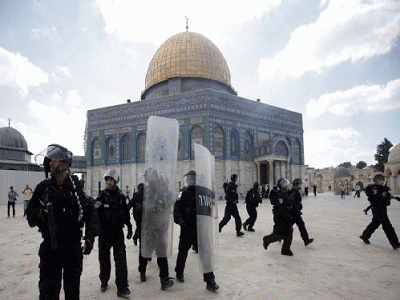
Israel soldiers attacking worshipers at Haram al-Sharif.
(Image by (Photo: Palestine Chronicle File)) Details DMCA
As I was growing up, I was always reassured by the sound of the "Muadhin" making the call for prayer in our refugee camp's main mosque in Gaza. Whenever I heard the call very early in the morning, announcing in a melodic voice that the time for the "Fajr" (dawn) prayer was upon us, I knew it was safe to go to sleep.
Of course, the call for prayer in Islam, like the sound of church bells ringing, carries a deep religious and spiritual meaning, as it has, five times a day, for the last 15 centuries, uninterrupted. But, in Palestine, such religious traditions also carry a deep, symbolic meaning.
For the refugees in my camp, the dawn prayer meant that the Israeli army had departed the camp, ending their terrifying and violent nightly raids, leaving the refugees behind, either mourning their dead, wounded or detained, and freeing the "Muadhin" to open the mosque's old, rusty doors, and announce to the faithful that a new day had arrived.
It was almost impossible to go to sleep during those days of the First Palestinian Uprising, when collective punishment of Palestinian communities throughout the Occupied Territories crossed every tolerable line.
That was before the mosque in our camp -- the Nuseirat Refugee Camp in central Gaza Strip -- was raided, along with other mosques, and the Imam was arrested. When the mosque's doors were sealed shut by orders from the army, ordinary people climbed to the roofs of their homes during the military curfew and announced the call for prayer, anyway.
Even our "communist" neighbor did -- a man, we were told, who had never stepped foot inside a mosque all of his life!
It was no longer just a religious matter but an act of collective defiance, proving that even orders from the army would not silence the voice of the people.
The call for prayer meant continuity; survival; rebirth; hope and layer-upon-layer of meanings that was never truly understood, but always feared by the Israeli army.
The onslaught on the mosques never ended.
According to government and media reports, a third of Gaza's mosques were destroyed in the 2014 Israeli war on the Strip. 73 mosques were entirely destroyed by missiles and bombs and 205 were partially demolished. This includes Al-Omari Mosque in Gaza, which dates back to 649 AD.
It also includes the main mosque of Nuseirat, where the call for prayer throughout my childhood gave me enough peace and calm to go to sleep.
Now, Israel is trying to ban the call for prayer in various Palestinian communities, starting in Occupied East Jerusalem.
The ban came only a few weeks after the United Nations culture and education organization, UNESCO, had passed two resolutions condemning Israel's illegal practices in the occupied Arab city.
UNESCO demanded that Israel cease such practices, which violate international law and attempt to alter the status quo of a city that is central to all monotheistic religions.
(Note: You can view every article as one long page if you sign up as an Advocate Member, or higher).
 2
 1
 1