




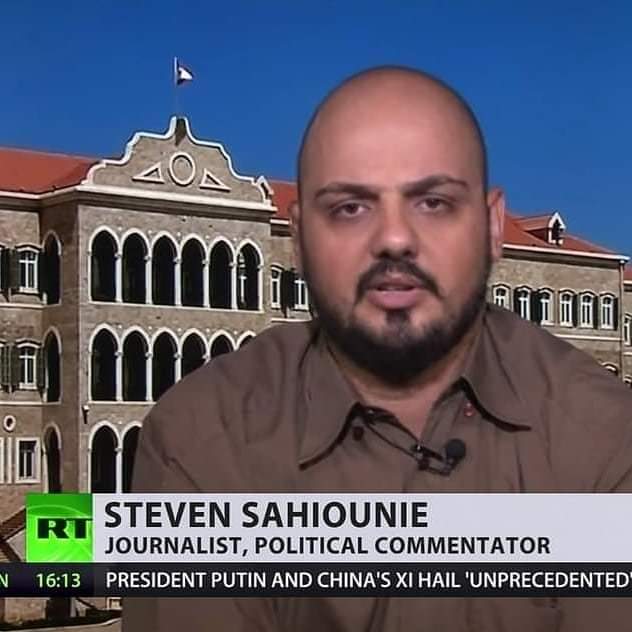


By: Steven Sahiounie, journalist and political commentator
The unprovoked attack on Iran by Israel and the US on February 28 has been a disaster for Lebanon. While the world is watching the Trump war with Iran unfold in the Persian Gulf, far away Lebanon is under almost daily attacks and further occupation by the Israel Defense Forces.
Between 4,057 and 4,386 fatalities have been recorded from Israeli airstrikes and invasions in Lebanon, while over 12,100 people have been wounded. More than 1.2 million people have been displaced across Lebanon.
In an interview with journalist Steven Sahiounie, Ougarit Dandash, Lebanese writer, media figure, and Head of Media for the Syrian Social Nationalist Party, discusses Lebanon’s sovereignty, border security, the return of displaced Syrians, international reconstruction assistance, regional escalation, the role of resistance, and the future of UNIFIL in southern Lebanon.
#1. Steven Sahiounie (SS): Controlling Lebanon’s land and maritime borders, combating smuggling, and resolving the issue of displaced Syrians are among the principal demands of both the international community and the Lebanese public. What practical steps can be taken to implement these understandings without compromising national sovereignty?
Ougarit Dandash (OD): We must first move away from an approach that treats these issues primarily as responses to the demands of the international community. Border control, combating smuggling, and regulating cross-border movement are, above all, responsibilities of the state and matters of national interest.
There is, however, a fundamental difference between a state managing its borders in accordance with its sovereignty and economic and security interests, and those borders becoming an instrument for implementing policies imposed by external parties in pursuit of foreign agendas. Some actors want the Lebanese state to serve as a border guard for their own interests.
Lebanon and Syria share geographical, economic, social, and historical ties that cannot be reduced to a line on a map. This does not mean that border regulation is unnecessary. On the contrary, the current circumstances make institutional cooperation between the two countries even more urgent.
In practical terms, we need direct official coordination, the development of legitimate border crossings, stronger customs oversight, and effective action against smuggling networks that exploit corruption and institutional weakness.
However, the current governing establishment in Damascus complicates matters. On the one hand, we hear Western calls, particularly from the United States, urging the Syrian government to enter Lebanon and fight a Lebanese political faction. On the other hand, the Syrian side has not articulated a sufficiently clear position regarding these demands.
As for the issue of displaced Syrians, it cannot be treated merely as a security or demographic problem. It is a humanitarian, political, and economic issue.
Resolving it requires examining why such large numbers of Syrians remain in Lebanon, having initially arrived under the stated justification of fleeing the former Syrian regime. It also requires coordination among the countries concerned and the creation of conditions conducive to their return, rather than simply managing the consequences of their continued presence.
Most importantly, we must ask a fundamental question: Who benefits?
Who benefits politically and economically from their continued presence? Who benefits from the funds allocated to this issue? And who has profited from the corruption and alleged theft associated with its management?
These questions deserve serious investigation if Lebanon is to develop a sustainable and effective policy.
#2. SS: Lebanon faces major challenges in rebuilding damaged areas and restructuring its banking and financial sectors. Do the Lebanese have a genuine opportunity to obtain Arab and international support for reconstruction, or will such assistance remain conditional on difficult political and security concessions?
(Note: You can view every article as one long page if you sign up as an Advocate Member, or higher).






