






When was the last time you taught your 15-year-old to drive "stick" in your brand new sports car? When was the last time you and the 15-year-old thought denting other cars in traffic was funny and made jokes about it like "was that expensive"?
This radio sitcom is part of a new ad campaign from the gas and oil giant BP whose campaign line is that you "have more important things to worry about"--let BP worry about the "quality of your gas."
Another droll ad in the series has several of "Bobbie's buddies" driving 250 miles for his bachelor party with "plenty of ibuprofen," letting BP worry about the quality of their gas. Cute.
After a corporation has visited huge damage on humans and other living things, it usually lays low for years. No one, for example, will probably hear a peep out of Germanwings, whose flight 4U9525 crashed into the Alps, until, say 2030. Blackwater, after being charged with the 2007 Nisour Square massacre in Iraq in which unarmed civilians were gunned down, did not just lay low--it changed its name.
But for some reason BP thinks there's no hard feelings from its 2010 Gulf oil spill, the largest oil spill in U.S. history. Official estimates say BP's oil spill killed 6,381 birds including 577 brown pelicans but wildlife experts say those numbers are easily ten time that and maybe much more. Why? Because accurate counts of destroyed wildlife are difficult because many are killed by predators and most try not to die in the open--but to find a hidden place.
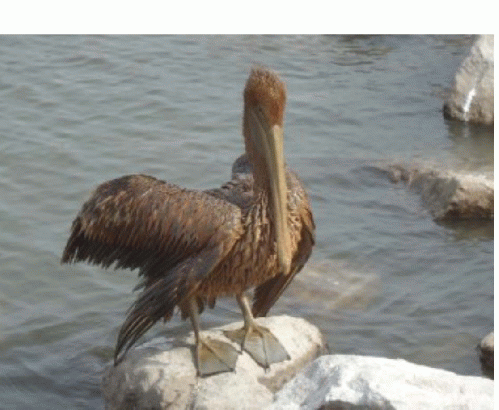
To avoid causing more deaths, the decision was made to not recover dead birds from the nesting islands until months after the spill said Melanie Driscoll, the National Audubon Society's director of bird conservation for the Gulf Coast. Pelicans who survived oil soaked deaths brought the oil back to their nests on their feathers which then covered the eggs. When "surviving young were old enough, they walked and swam through the weathered oil around the booms," reported The Lens.
Nor are dead and suffering birds and their offspring the only lasting damage BP caused to the Gulf region. According to an ongoing investigation by the National Oceanic and Atmospheric Administration (NOAA) into the BP spill, there are clear links to current and ongoing mass dolphin deaths in Alabama, Louisiana and Mississippi. Scientists have found more instances of adrenal and lung lesions in dolphins dying near the Deepwater Horizon spill than in non-exposed dolphins. Thank you, BP.
(Note: You can view every article as one long page if you sign up as an Advocate Member, or higher).
 2
2
 2
2
 1
1






