







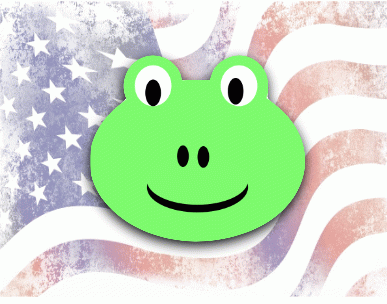
I was just working on the finishing touches of a little frog graphic in support of Portland Frog, when my friend Susan shared this brilliant assessment, The Courage to Mock the Machine by Tony Pentimalli, who gave me permission to post it in full here.
The Courage to Mock the Machine
By Tony Pentimalli
At this point, Im sure youve all seen the viral clips-a lone protester in a green frog costume with a blue scarf, standing before a wall of armored officers in Portland, Oregon. Behind those shields stood men trained to see enemies, not citizens. Yet in that absurd tableau-a cartoon staring down a government-something deeply human broke through. The frog said nothing. It didnt have to. Its mere presence, a splash of color against the monochrome of authority, turned the states performance of power into farce. In that silence between absurdity and fear, something sacred was reclaimed: the right to mock the machine.
Authoritarian power depends on spectacle. The gleam of riot gear, the rhythmic bark of commands, the gas rising in the air, it is theater meant to project dominance and provoke fear. The show is designed to make the citizen feel small, fragile, and hopeless. But when the citizen refuses to play along, the illusion falters. The frog did more to expose the theater of repression than a hundred speeches could have. It revealed how easily fear collapses under the weight of laughter.
Soon, the frog wasnt alone. Across Portland, others joined-protesters dressed as jesters, astronauts, angels, chickens, superheroes, and inflatable unicorns-each costume transforming the nights tension into a living act of satire. The streets became a surreal carnival of resistance. Darth Vader stood beside a ballerina. A man in a banana suit carried a sign that read Peel Back the Lies. Viral footage shared by Portland livestreamers and local collectives spread across social media under the tag #CostumesForFreedom, as artists and teachers, nurses and students took to the streets not with slogans but with irony. It was rebellion through laughter, a movement built not on anger but on the refusal to surrender joy. Every costume was a mirror. Every laugh, an act of defiance.
What these protesters have done goes far beyond parody. Their humor has become a weapon that cuts through propaganda, one that forces the authoritarian regime to expose its own absurdity. The Trump administration has spent months painting Portland as a city under siege, a battlefield of chaos requiring the steady hand of militarized order. But when footage shows riot police squaring off against inflatable dinosaurs, frogs, and angels, even the most hardened supporter is forced to confront the farce. The regimes story collapses under the weight of its own overreaction. How can a government claim a war for civilization when its enemies are frogs with megaphones?
The ICE agents and National Guard units who have flooded cities like Portland are not seasoned warriors. Training has been shortened, oversight reduced, and soldiers are often deployed with minimal experience, armed but uncertain, scripted for a performance of control. Every show of force, every phalanx of riot shields and armored trucks, is choreographed for the cameras. Any protest that police in riot gear show up to looks like a riot by nature of the police and riot gear being there, one observer said. Thats the point. The state creates the image of chaos to justify its own existence.
But humor dismantles that illusion. The frog costume, the songs, the street theater, they are not distractions. They are counterprogramming. The Serbian youth movement Otpor knew this two decades ago when they mocked Slobodan Miloevi by placing his portrait on a barrel and leaving a bat beside it. Citizens lined up to take a swing, laughing all the while, while police scurried to arrest the barrel itself. The absurdity of the regime was laid bare, and laughter became resistance. From the court jesters who risked their heads mocking kings to the students and artists of Pragues Velvet Revolution in 1989, humor has always been the forbidden language of the oppressed.
The same courage lives now in Portland. The humor is disarming, but not harmless. Many whove donned costumes have been arrested, beaten, or quietly added to watch lists. The price of laughter under authoritarianism is often paid in bruises. But these protesters understand the deeper truth: that tyrants cannot survive exposure. They depend on darkness, fear, and the illusion of being too powerful to mock. The moment citizens laugh, the mask slips and the myth of control begins to crumble.
Trumps enforcers are desperate for violence, a predicate, as one analyst put it, to legitimize their crackdowns. Stephen Miller and his allies keep insisting that the streets are on fire, hoping the spectacle will justify the script. But when protesters show up in costumes, singing parody songs or standing silently in cartoon suits, the predicate dissolves. There is no enemy to conquer, only the image of power humiliated by its own overreaction. Why are we deploying military on the streets to fight cartoon characters? one observer asked. There is no answer that doesnt sound ridiculous.
That ridiculousness is precisely what makes this movement so powerful. Because every time the state deploys its might against laughter, every time a frog meets tear gas or an angel is shoved to the ground, the illusion of moral authority dies a little more. What these citizens have done is not only reclaim the language of protest, they have rewritten the optics of resistance itself. They have shown that tyranny, for all its brutality, is fragile when stripped of theater.
If there is a lesson here for every city where the administration deploys troops or fills an intersection with shielded, armed police, it is simple and strategic. Meet the spectacle not with more fear but with a wardrobe department turned inside out. Every deployment should be answered by a contingent straight out of Madagascar: costumes, music, choreography, absurdity deployed en masse. Not as a stunt, but as a disciplined tactic-organized, nonviolent, and public. A carnival of resistance forces the cameras to choose which story to tell. It compels even loyalists to squint and ask whether a city under siege can plausibly be a city where people are dressed like penguins and dancing in formation. That forced contradiction is a political weapon. It dissolves the predicate, drains the propaganda of its power, and makes it harder for neutral observers to accept the administrations narrative.
This strategy is not without risk. Costume brigades will be arrested, photographed, and surveilled. Organizers must plan for legal defense, de-escalation training, and clear nonviolent discipline. The point is not to humiliate individuals but to reveal a system. When a unit of soldiers is made to look ridiculous by an organized, joyful crowd, the crowd has not lowered itself; it has exposed the emptiness of the state spectacle.
(Note: You can view every article as one long page if you sign up as an Advocate Member, or higher).






