| Back OpEd News | |||||||
|
Original Content at https://www.opednews.com/articles/Wasserman-and-Fitrakis--W-by-Marta-Steele-121104-579.html (Note: You can view every article as one long page if you sign up as an Advocate Member, or higher). |
|||||||
November 4, 2012
Wasserman and Fitrakis, "Will the GOP Steal America's 2012 Election?"
By Marta Steele
Review of an excellent retrospective on electoral corruption in the United States throughout its history and most particularly on the years 2004-2012, and what the events portend for the future of our democratic government.
::::::::
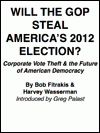
History is so important. Norman Mailer said that all writers must know history. Professors Bob Fitrakis and Harvey Wasserman certainly do. They write the history no one else does--of election corruption in their home state, Ohio, and throughout the country since 2004.
Most recently, even more recently than the publication of their book this year, they have revealed to the public the strong connection between the Romney family and Hart InterCivic, the nation's second-largest voting machine manufacturer and custodian that participates in the electoral process beyond delivering the hugely defective product. H.I. operatives also help at the polls of their clients all over the country, with all of their equipment.
Need I say more?
Since the publication of his brand-new book Billionaires and Ballot Bandits, investigative journalist and author Greg Palast has revealed the blind-trust connection between the Romneys and the bailout of the automobile industry during the great recession back in 2008. Though hardly in need of assistance themselves, they profited from buying out another bankrupt entity, Delphi Auto Parts, for pennies and then going public on the Dow and raking in dollars, as much as 115 million of them. Now GM, along with its colleagues, can't do without auto parts, which are essential to the manufacture of cars. Strangled by gluttony and avarice, they paid the price demanded by these religious people, straight out of their bailout funds and ours.
Palast, in his outstanding Foreword, lauds the erudition and importance of the authors' works and how we have all benefited from them inestimably, those enlightened enough to read their work anyway.
A massive grassroots upheaval is needed, for six compelling reasons (in addition to the new ones specified above), one that should have arisen far sooner, notes Palast in his Foreword. The reasons are the massive billions freed to spend on political campaigns thanks to Citizens United; the Electoral College, which forces focus on the swing states--campaigning since the party conventions has been confined to ten states; the disenfranchisement in infinite ways of the downtrodden of all descriptions who would naturally vote Democratic; the use of electronic voting machines as a particularly potent disenfranchiser; and finally, the Progressives' alienation from the President, only recently receding in the face of the hideous monster that threatens a disastrous upheaval, beginning with negatives: bye-bye, Obamacare, Public Television, most of Medicaid . . . the list goes on.
At least Obama began positively by announcing his intention to close the prisons at Guantanamo.
But then, thank God, ways out of the quicksand are listed, six of them, as above: take money out of politics; nonpartisan election administration; automatic registration of all U.S. citizens upon reaching age eighteen; polls that are located accessibly; an extended voting period, with "Election Day" lasting four days that include a weekend; and hand-counted paper ballots as the only voting vehicle, which means doing away with electronic voting, a huge conduit for election corruption.
The ways elections are stolen are described in depth in the next section, followed by an invaluable section on the history of stolen elections dating back to the controversy that put one stunning founding father into office who defeated another, Thomas Jefferson and John Adams, respectively.
Jim Crow was born, more or less, when the southern states feared loss of power because of the hugely larger population in the North; each of their slaves was therefore counted as three-fifths of a person when it came to the vote they were not allowed to cast until the Fifteenth Amendment was ratified in 1870. The real Jim Crow era was ushered in soon after as a result of another crooked election, decided by back-room bargains that removed Yankee troops from the South, demolishing Reconstruction and the partial protection it had extended to freed slaves who did not migrate north. This was the Tilden-Hayes contest that Tilden actually won but Hayes subsequently sewed up.
Then there were three other corrupted elections: those of John Quincy Adams, William McKinley, and George W. Bush.
Third parties, including Socialists and two waves of Progressives, have been influential between then and now, though a three- or four-party system is still way off the radar. The authors wonder how many votes these and other parties really won in presidential elections and how many of these have been stolen. Will we ever know? Paper ballots back then were perishable in an infinite number of ways; today I'm sure they can be preserved at least as well as electronic data.
The definitions of a Republican and a Democrat so deviate from the partisan histories that both founders, Abraham Lincoln and Andrew Jackson, would turn over in their graves if they knew what had become of them. I therefore reject nineteenth-century associations of them with their later incarnations. Once can almost but not completely decide that if these founding figures were switched around, the associations might be more appropriate.
Such is history, that ironic pursuit that conceals as much as it narrates.
There follows the largest-by-far section, the Critical Anthology, covering 2004--2008, which collects articles previously published by the authors (most originally published at Freepress.org), including "Diebold's Political Machine," first published in Mother Jones in 2004. It documents, probably for the first time, Walden O'Dell's notorious promise to win Ohio for Bush in 2004. O'Dell was the infamous CEO of the company at that time.
Bev Harris's emergence as a key leader of the emerging Election Integrity movement is next documented when the authors turn to describing the other industry giant, ES&S, and Harris's stunning account of how its former CEO, Chuck Hagel, easily won Nebraska's 1996 senatorial election he entered after stepping down from this post.
Other events chronicled in this article include the reason for Gore's first concession in the early morning after Election Day 2000 and Harris's role in informing the public of the details of the massive and deceptive Diebold computer error that subtracted 16,022 votes from Gore's total--she obtained the details by means of internal memos she got ahold of, a total of thirteen thousand pages pirated from the infamous company by various hackers.
The successful theft of the 2004 Ohio election and thence the presidency is anticipated and then chronicled in meticulous detail, focusing on events within the Buckeye State's eighty-eight counties, fifty-six of which, the authors reveal, illegally disposed of their election records before the authors and their colleagues could subpoena them for research purposes. The actual recount, paid for by the Green and Libertarian parties rather than the $7 million that had been reserved for this purpose by the Kerry campaign, was totally inaccurate and compromised because the sample counties were purposefully chosen, rather than at random, as was legal and also statistically far more valid.
Key events outside of Ohio, including in Texas and Florida, are also covered--lists of supposed ex-felons and blatant racism, respectively.
Particularly notable is the 2008 article that argues for the need for paper ballots in the wake of a large hurricane, Ike (landfall in Texas Sept. 13, 2008), which deprived the Midwest of power for several days. To use electronic equipment would definitely jeopardize the validity of the results (as if it didn't before then). A controversial outcome in Ohio, where Obama's lead has been described as "razor-thin," is anticipated. Also chronicled is the Supreme Court decision not to allow a recount of Ohio's votes that involved slight inconsistencies in documenting voter names across various major databases and invalidating any registrations, and hence votes, which deviated in terms of typos or misspellings. "Based on projected demographic and voter turnout statistics, the elimination of these four-fifths of a million voters (some 5.4 million votes were counted in Ohio 2008) could have shifted a 200,000-vote victory for Obama to a 40,000-vote"-triumph for McCain," write Fitrakis and Wasserman.
More speculations about and retrospectives on Election 2008 follow, in particular an event that should be common knowledge, Cybergate. That term describes the successful project in Ohio the night of Election 2004 to shift the electoral advantage of the candidates by means of a "man in the middle" cyber structure that extended from the secretary of state's (Kenneth Blackwell at the time) office down to a contracted server in Tennessee. A map of this complex structure is reproduced, part of the legal brief submitted by co-counsel Fitrakis and his colleague, Cliff Arneback, chief counsel in the lawsuit, the same one later offered as evidence of the theft of Kerry votes in Ohio as part of the ongoing King-Lincoln Bronzeville v Secretary of State Kenneth Blackwell (and subsequently SoS Jennifer Brunner) lawsuit that attempted to prove and out the infinite number of acts of corruption that had prevented the rightful winner, John Kerry, from prevailing in the state and hence in Election 2004.
Articles published after Election 2008 explore the highly suspicious death of Rove's IT guru Mike Connell, who engineered the Cybergate event, and other attempted strikes against the master manipulator of politics and human destinies here and throughout the world. At one point Rove is served with a subpoena in front of a television network building in Manhattan and throws it on the ground. Somehow, though no longer employed by George W. Bush, this guru of all things destructive and evil has previously ducked two subpoenas by the House Judiciary Committee under Rep. John Conyers (D-MI) and numerous other attempts to corner and punish him. When I asked Bob Fitrakis how Rove got away with it again and again, his answer was "clever lawyers."
Can Rove come over to your house for a bowl of soup when he goes bankrupt over all the legal bills, or are his attorneys blackmailed in return for their services? A well-kept secret?
Other stunning research further explores Election 2004 and then ruefully anticipates Election 2012: "1,092,392 voters . . . removed from the voting rolls since the last presidential election"; the publicity the press has finally given to election corruption in many of its hideous forms; and "the defeat of millionaire Republican Governor John Kasich's union-busting Issue 2 by more than 20%[, which] actually squared with exit polling and other reliable political indicators."
The Afterword, by Greg Palast, which comprises the first chapter of his Billionaires and Ballot Bandits, offers compelling statistics on how many voters were disenfranchised in Election 2008--nearly six million, which the Truth Sleuth says are simply not enough for Rove. He wants more.
The only way to fully appreciate Wasserman and Fitrakis's massive, masterful, and ongoing effort to inform the public about the infinite number of backstage machinations that threaten the integrity of future elections at every level, is to read the book. This invaluable archive is available for only $4.95 at www.freepress.org as an e-book.
Authors Website: http://www.wordsunltd.com
Authors Bio:
Marta Steele is an author/editor/blogger who has been writing for Opednews.com since 2006. She is also author of the 2012 book "Grassroots, Geeks, Pros, and Pols: The Election Integrity Movement's Nonstop Battle to Win Back the People's Vote, 2000-2008" (Columbus, Free Press) and a member of the Election Integrity movement since 2001. Her original website, WordsUnLtd.com, first entered the blogosphere in 2003. She recently became a senior editor for Opednews.com. She has in the past taught college and worked as a full-time as well as freelance reporter. She has been a peace and election integrity activist since 1999. Her undergraduate and graduate educational background are in Spanish, classical philology, and historical and comparative linguistics. Her biography is most recently listed in "Who's Who in America" 2019 and in 2018 she received a Lifetime Achievement Award from Who's Who.