


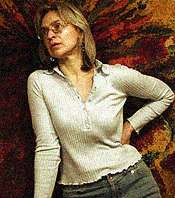
"The 'Chechnya' special operation has infected the whole country, which is becoming more and more beastly and idiotic. The value of human life was already very low in Russia, and now it has slipped to almost nothing. We have all reached the depths, like the unrescued Kursk [the sunken submarine]. And there's no order for rescue." -- "A Small Corner of Hell: Dispatches from Chechnya" by Anna Politkovskaya (University of Chicago Press, 2003)One hundred twenty-six journalists have been killed in Iraq, many of them native to the country. We don't mean to slight them, but we've chosen one from elsewhere to represent all journalists whose lives are imperiled. It's not just that she demonstrated as much courage as any journalists that ever lived while reporting on a conflict, the Chechnyan Wars, at least as savage as Iraq. But from the standpoint of convenience, it's easier to examine her life because a large body of her work is available in English. Anna Politkovskaya wrote for a Moscow periodical critical of Russian government policy. Its initial funding was provided by -- get this -- Mikhail Gorbachev. He used the money he won for his 1990 Nobel Prize to found Novaya Gazeta in 1993. Imagine the American corollary? All you can come up with is Jimmy Carter helping get a new American Prospect off the ground with his Nobel Prize money. And that's a stretch. The Chechnyan separatist movement never garnered much sympathy in the US. What little most of us know about it is, for one, the 2002 Moscow theater hostage crisis (known to Russians as "Nord-Ost," after the production playing there at the time). After Chechnyan terrorists seized the theatre, 39 of them were killed in the chaos that erupted when Russian forces flooded the theater with poison gas. Worse, 129 to 200 of the hostages lost their lives as well. Second, of course, we remember the Beslan school hostage crisis in 2004, which ranks as one of the most hideous events in this or any century. After another typically heavy-handed Russian response, at least 334 civilians were killed, including 186 children. In both incidents, Politkovskaya herself was called upon to help negotiate the release of hostages with rebels who knew of her reputation. But they weren't separatists as much as terrorists taking revenge for Moscow's oppression of their people in the wake of the Chechnyan separatist movement's onset. From 1989 to 1991, the Russian republics, like Estonia, Ukraine, and Belarus, asserted their independence. When Chechnya, a small republic followed suit, Russia gambled that it could hold on to it without the major war required to prevent the large republics from leaving. It's not that Russia minded losing Chechnya. It's just that its secession set a bad example for the other small republics whose resources and industries were more valuable to Russia than Chechnya's. During the First Chechen War, from 1994 to 1996, the Russian forces, despite obvious superiority, were unable to establish control over Chechen guerrillas in mountainous areas. Then the separatists seized a hospital in Budyonnovsk, a city in Southern Russia. As with Beslan and Nord-Ost later, the troops were blamed for killing more hostages, over 100, than rebels. A shock to the Russian public, it discredited the Russian government's mission in Chechnya. 7,500 Russian military, 4,000 Chechen combatants, and from 35,000 to 100,000 civilians dead later, Russian President Boris Yeltsin declared a ceasefire in 1996 and signed a peace treaty a year later. But in 1999, unwilling to leave well enough alone, Chechnyan guerillas tried to invade the neighboring republic of Dagestan. After enduring a series of apartment bombings in their cities, including Moscow, the Russian people were less inclined to object this time when its government, working with increased efficiency, installed a pro-Moscow regime in Chechnya. From 2000 to the present, Russian officials have periodically declared the war is over. While attacks continue in the north, Chechnya, in fits and starts, is finally undergoing reconstruction. Throughout both conflicts, Politkovskaya interviewed Chechnyan victims in their homes, as well as in hospitals and refugee camps. In addition, she talked to Russian soldiers and federal authorities. She portrayed wars in which thousands of innocent citizens were robbed, abducted, tortured, raped, or killed by, at first, Russian military forces and the Russian-backed Chechen administration. Later Chechens themselves joined in preying on their people. As Politkovskaya explained in "A Small Corner of Hell," "Nighttime criminals attack the ruined homes of people who are already wretched enough as it is. On the one hand, this criminality is led and encouraged by Federal servicemen. . . . shooting, robbing, and raping. [Eventually] the gangs combing the ruins at night are a fraternity of criminals from the Chechen ranks, mixed with [Russian] servicemen [none of which] give a damn about. . . the fact that they belong to opposing sides." And you thought you couldn't tell the players in Iraq without a scorecard. Poltikovskaya may have sealed her own fate with another book, "Putin's Russia: Life in a Failing Democracy" (Metropolitan Books, 2005). Besides chronicling the Russian leader's brutal pursuit of the Second Chechen War, it also accused the Russian secret service, the FSB, of stifling dissent. Nor was the Russian public spared. "It is we who are responsible for Putin's policies," Poltikovskaya wrote. Its rejection of the first war notwithstanding, "Society has shown limitless apathy. . . . The KGB respects only the strong. The weak it devours. We of all people ought to know that." Of her profession, Politkovskaya maintained that "if you want to go on working as a journalist, it's total servility to Putin. Otherwise, it can be. . . the bullet, poison, or trial -- whatever our special services, Putin's guard dogs, see fit." Anna Politkovskaya was found shot dead in the elevator of her Moscow apartment building on October 7, 2006. Organizations like PEN and Amnesty International, both of which had given her awards, issued the expected denunciations. Also, more than 1,000 Russians, bravely distinguishing themselves from the ranks of the apathetic, filed past her coffin. That Politkovskaya's murder occurred on Putin's birthday helped point the way toward official complicitness. If what was a likely attempt to curry favor with the president weren't so obvious, the suspects might have avoided arrest. But an FSB colonel, an officer from the Department for Fighting Organized Crime, and a federal authority in Chechnya were apprehended. In August 2007, Novaya Gazeta journalists and Anna's grown son issued a statement concurring that those arrested were indeed deserving of investigation, still supposedly ongoing. Parallels can be drawn between Politkovskaya's work and that of the great Russian World War II journalist Vasily Grossman, who, arguably, saw more of life than any journalist in the history of the planet. (If that sounds hyperbolic, refer to "A Writer at War: Vasily Grossman with the Red Army, 1941-1945" by Anthony Beevor and Luba Vinogradova [Pantheon, 2006]). While no one can match the range of Grossman, Politkovskaya enjoyed one advantage over him -- the opportunity to interview participants and victims on both sides of the conflict. But Grossman, too, incurred the wrath of the Russian government. He wrote odes to the Russian people and soldiers during the war that may well have helped inspire them to victory. But, after the war, he turned his efforts to documenting the crimes of the Holocaust during a period of vehement official anti-Semitism, as well as those of his own government during the collectivization of the late 1920s and early thirties. As a result, he was reduced to the status of a non-person who couldn't get his novels published. It's one thing for journalists, caught up in a noble cause, to endanger their own lives. But the pressure on them is exponentially intensified when the effect on their families is taken into consideration. The claim "I have a family" might seem like an excuse for journalists or would-be whistleblowers to avoid taking the high road. But the decision to put your family in a state of crisis, not to mention harm's way, obviously can't be taken lightly. Taking responsibility for placing your family in that situation requires a breed of courage seldom seen and even less understood. This was best illustrated when the Nord-Ost terrorists asked to see Politkovskaya. "I say 'yes,'" she wrote in "A Small Corner of Hell." "My son manages to get through to me in the midst of all the people calling me: 'Please don't do this! We can't take it anymore!' . . . It's a difficult conversation. "He can't even express in words how tired everyone around me has gotten from these experiences that take up their whole lives. . . . But later, he will help me more than anyone else with the negotiations, talking with the terrorists on the phone until my arrival." But, after the attack, "the FSS [Federal Security Service] will put him under surveillance, listening to his phone conversations." However unlikely a legacy, at least Anna Politkovskaya could die secure in the knowledge that while her son would scarcely treasure it, he appreciated it. As do those with respect for human rights everywhere.


 73 73
  
Pushing the Envelope of Journalism Until It's Inside-out |
|
| Rate It | View Ratings |
Russ Wellen Social Media Pages: 


Russ Wellen is the nuclear deproliferation editor for OpEdNews. He's also on the staffs of Freezerbox and Scholars & Rogues.
"It's hard to tell people not to smoke when you have (more...)
The views expressed herein are the sole responsibility of the author
and do not necessarily reflect those of this website or its editors.




OpEdNews depends upon can't survive without your help.
If you value this article and the work of OpEdNews, please either Donate or Purchase a premium membership.
STAY IN THE KNOW
If you've enjoyed this, sign up for our daily or weekly newsletter to get lots of great progressive content.
If you've enjoyed this, sign up for our daily or weekly newsletter to get lots of great progressive content.
Most Popular Articles by this Author: (View All Most Popular Articles by this Author)
Foxy Knoxy and the Case of the Honorary Missing White Woman
You All Know Hanoi Jane, Now Meet Tehran Todd
School, Mall and Workplace Shootings: Why So Many?
What's It Like Waiting Around to Be Bombed?
Is a Preemptive Strike Ever Justified?
To View Comments or Join the Conversation:
