




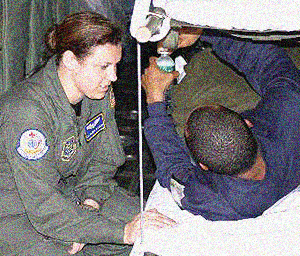
"60 Minutes" recently ran a story about the care American troops (as well as some token locals) receive when injured in Iraq. "Chief of trauma at the giant American Medical Center in Landstuhl, Germany, Dr. Dorlac," reads the transcript, says that the care of one injured soldier "involved a dozen aircraft and maybe a thousand Air Force personnel."
Reporter Scott Pelley remarks, "No one would want to, care to, put a price tag on this, but just to get a sense of the scope, it probably isn't unreasonable to believe a million dollars was spent on this young man to save his life."
Dr. Dorlac replies, "I'd say that's probably a good conservative number." American troops in Iraq are seldom more than half an hour from medical help. The combat support hospital that "60 Minutes" filmed compares favorably to a big-city emergency room. But most striking are the cavernous interiors of the cargo planes -- usually stripped down and stark -- that are transformed into flying hospitals. Staffed by "aeromedical" units, they ferry injured troops from Iraq to treatment facilities in Germany.
Some think this war was staged in part to let Rumsfeld act out his Rommel fantasy and send his specialized army racing around the desert. After watching the "60 Minutes" episode, one could be forgiven for wondering if Iraq was also a test-run for state-of-the-art medical equipment and procedures.
When it comes to Iraq, nothing brings the sheer impotence of our anger to a fever pitch like our troops being picked off and blown apart in a fanciful war. But, personally speaking, there's another tributary feeding this river of rage. Is there anyone else out there who finds the amount of money and ingenuity invested in patching up our troops offensive?
Of course, like Pelley says, when it comes to saving soldiers' lives, break the bank. What sticks in the craw, though, is how military medicine got sucked into this vortex of cleaning up after Bush & Co.'s mess. Sure, army doctors and nurses are only doing their jobs. But there's something about it that can only be called. . . enabling.
It's not unlike those who maintain we can't just up and leave Iraq lest it descend from slaughter to genocide. But Bush & Co. have never seemed too concerned with the casualties, chaos and collective collateral. Why then is it up to the rest of us to clean up their mess for them?
Because, comes the reply in true enabler fashion, they won't.
Most Americans, however, don't concern themselves with Iraq. The reasons are legion and run the gamut from that old standby apathy to a visceral inability to deal with the carnage. Sure, the way we divert ourselves with iFun from high-tech phones to high-def TV leaves us open to charges of denial.
But maybe there's a silver lining to our inattention to Iraq. Perhaps we just don't think that Iraq has anything to do with us. We may have supported the invasion, but, since it was started under false pretenses, we soon found fault with it and returned it to sender.
In other words, Bush & Co. got themselves into Iraq -- let them get themselves out of it. We wash our hands of the whole mess. In fact, maybe ignoring Iraq is a sign of mental health for many Americans.
Nobody refused to take ownership for a questionable war better than Muhammad Ali. "I ain't got no quarrel with them Viet Cong," he said. He spoke for all citizens conscripted -- whether bodily or just emotionally -- into a war that, like today's, was the idée fixe of a sect-like clique in the government.
Unlike those who've become invested in the war, much of the public refuses to enable the Iraq abusers any longer. But while divesting ourselves of Iraq is an important step on the road to maturity, we need to leverage it to confirm our continued emotional growth.
Armed with a newfound objectivity, we're strong enough to confront the issue free of fear it will engulf us. Approaching it like any relationship, we need to advocate a clean break, always preferable to a winding down, which only prolongs suffering.
But withdrawal of our troops is, to some extent, a straw man -- many will still be stationed in permanent bases in Iraq. Still, by all rights, this should expedite drawing back from the front lines because it provides insurance in case the country then moves from conflagration conditions to an outright inferno. Our troops would then step forth to extinguish the fire.
(Note: You can view every article as one long page if you sign up as an Advocate Member, or higher).






