


Tags for This Article:

Corruption (1674)  History (1006)  God (735)  Death (705)  Torture (687)  Immigration (589)  Torture (409)  Africa (275)  Apartheid (141)  SOUL (113)  Congo (87)  South Africa (78)  Zimbabwe (36)  Xenophobia (3) 

Populum Tag Cloud
       Control Panel
Fine tune your search to access content
Articles
Diaries Products
Events All
All time
Last 6 mos
Last month
Last week
Last 24 hrs
From:
Month  Day   Year

To:
Month  Day   Year
Alphabet
Popularity
Count ON
Count OFF
This Level
Sub-levels


Tag(s): ; ; ; ; ; ; ; ; ; ; (more...) ; ; ;  (less...)
Add to My Group
May 27, 2008 at 03:28:58

Headlined on 5/27/08:
Reports from South Africa Focus on Crime and Ignore History

by Georgianne Nienaber     Page 1 of 2 page(s)

www.opednews.com


Tell A Friend

(0.0 from 0 ratings) View Ratings | Rate It


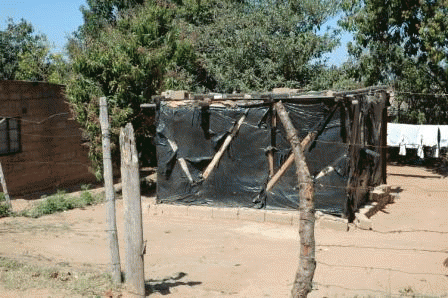
A home in the Homeland

Dateline South Africa—The black priest spoke of all of the places, of the great hills and valleys of his country. He also spoke of the sickness of the land, and how the grass had disappeared, and of the dongas that ran from hill to valley, and valley to hill. He spoke of how the “tribe was broken” and the house broken and the men broken. The group of concerned citizens of the township spoke of the sickness of the land, of the broken tribe and the broken house, of “young men and young girls that went away and forgot their customs and lived loose and idle lives.”

They talked of young criminal children, and older and more dangerous criminals, and of how white Johannesburg was afraid of black crime. One of them went and got the newspaper and showed him in big, bold black letters, “Old couple robbed and beaten in lonely house. Four natives arrested.”

This story could have been ripped from the headlines of South Africa today. And many of you reading this have been lulled into thinking that is so.

This summary passage was actually written by Alan Paton in what is probably the most important novel ever written about South Africa. “Cry the Beloved Country” was published in 1948 and details life in a beautiful country, engulfed by racial hatred in the days before and during apartheid. It is a novel steeped in hope and love and celebrates the dignity of humanity in the face of evil and oppression. The poor, the dispossessed and the forgotten in South African Townships face even greater challenges sixty years later.

Our mailbox has been flooded with pleas from South African white and black friends alike, asking us to stay on top of the stories coming out of their country these days. What the European Union has been reporting, and mainstream US media has been parroting, are stories of black on black violence which neatly fit into our colonialist ideals of a savage society that will only thrive under the mantle of white guidance and rule of “law.” Nothing could be further from the truth. Speak with black men and women in any country of the great continent of Africa, and you will hear the despair in their voices as they explain that the old tribal systems have been dismantled by “progress.” Tribal systems were the guardians of tradition, morality and convention until colonialist interventions dismantled this system and failed to offer anything in return except societal breakdown.

Our personal prism of western privilege allows us to view and define remote villages and “uncharted” regions of the world with “savage” and “tribal” elements. Our perception of the urban industrialized landscapes of the first world as “advanced” blinds us to the realities of the greater world community. In the rural areas of Africa the people’s lives and histories revolve around their intimate communities and connections with people, the land and tradition. To people living in Africa, white and black alike, the land is not exotic, wild or foreign, it is “home.” And home does not always provide safety and comfort.


South Africa 2007

In South Africa, the scourge to the Homeland is HIV and the menace of emerging resistant strains of tuberculosis. It is poverty and grave economic insecurity. One US dollar converts to almost 8 South African Rand. That is an increase of 2 Rand since this writer was there ten months ago. In Rwanda it is the legacy of the genocide. In the Democratic Republic of Congo it is the 1,000 people a day who die from starvation and disease in war-torn Kivu Province. The thousands of women and children who are raped, mutilated and set on fire are the true unlucky ones, for they are still alive. In Zimbabwe it is a corrupt dictatorship which has forced famine upon a fertile land. Consider that here are an estimated 5 million immigrants in South Africa who are often willing to work for low wages, inciting resentment and violence from the indigenous black population that has been faced with dismal standards of living for decades. Unemployment is nearing 40 percent. But who, or what, is really inciting violence? Is “inciting” even the correct word to use in this instance?

This in our box from an OEN reader:

“There have been incidents where South African citizens have been attacked, the media has started using phrases like ethnic cleansing and I have started hearing the words Civil War. There is a great deal of fear and distrust. The SA Government has been very slow to respond although the President addressed the nation yesterday (Sunday 25/05/2008), but from where I stand not much has changed, personally I feel that South Africa is on the knife edge, I hate to think what will happen in the coming days and nights.”

The only thing I can offer to the South African citizens who have emailed me to keep focus on this story is a dispassionate appraisal of the old journalistic tenets of “who,” “what,” “where,” “when” and a “why” that remains to be decided by a global community that has propped up, no questions asked, the “leadership” of President Thabo Mbeki.

The world press has been reporting the “what” of this story for the past two weeks. Xenophobic violence has claimed the lives of at least 50 people and forced 35,000 men, women and children to flee for their lives as violence has spread from the Zulu heartland (Townships) of Johannesburg to the countryside, Capetown, Durban, and beyond. The South African military is on the streets in the first display of force since the “end” of apartheid. President Mbeki directed the display of military force after a mob attacked a Nigerian-owned bar in Umbilo, located in the KwaZulu Province.

The presidential decision was announced after police said a mob of up to 150 armed men attacked a bar owned by Nigerians in Umbilo on last Tuesday night, injuring six people. Yesterday, 100 people returned to Umbilo, demanding foreigners leave the KwaZulu-Natal province. This province is located near the tourist playground of Durban. When protesters armed with stones and bottles attacked a men’s hostel in the tourist district, the rules seemed to change with the arrival of the military to quell the violence. However, refugees from African countries which include, Mozambique, Malawi and Zimbabwe were being set on fire in the townships of Johannesburg a week earlier. There was no comparable government response like there was in tourist-dependent Durban. Make of it what you will.

After the violence in Durban, the province's safety and security minister, Bheki Cele, a member of the ruling African National Congress (ANC), accused the mainly Zulu Inkatha Freedom Party (IFP) of being behind the attacks. He said: "There was a meeting of the IFP branch in Dalton yesterday [last Tuesday] and I know it was them,” according to reports in the South African press.

It is ironic that the ANC and the IFP were once closely aligned. Cracks in the alliance appeared in the 1980’s when ANC formed a political alliance with the United Democratic Front (UDF). This is when the term we are all hearing now, “necklacing,” first entered the journalists’ lexicon. The UDF killed opponents of the ANC by placing a tire saturated in petrol around the victim’s neck and then lighting it. Variations of this form of torture have been used on women and children in the Congo. We have seen the results there and death is preferred to life afterwards. In public, IFP deplored the violence at the end of apartheid, but there is significant evidence that some IFP members resorted to violence that was tacitly supported by the South African white police in an unholy alliance to prevent the formation of a South African State. Whispers are being heard now on the blogs and letters coming from South Africa, that it is possible such a “Third Force” is in play once again.

 1  |  2


Georgianne Nienaber is a writer, author, and investigative journalist. She lives in the world. Her articles have appeared in The Huffington Post, SCOOP New Zealand, Glide Magazine, Rwanda's New Times, India's TerraGreen, COA News, ZNET, OpEdNews, The Journal of the International Primate Protection League, Friends of the Congo, Africa Front, The United Nations Publication, A Civil Society Observer, and Zimbabwe's The Daily Mirror. Her fiction exposé of insurance fraud in the horse industry, Horse Sense, was re-released in early 2006. Gorilla Dreams: The Legacy of Dian Fossey was also released in 2006. Nienaber spent much of 2007 doing research in South Africa, Rwanda and the Democratic Republic of Congo. She was in DRC as a MONUC-accredited journalist, and recently spent six weeks in Southern Louisiana investigating hurricane reconstruction. She is currently developing a documentary on the Gulf of Mexico DEAD ZONE.

Contact Author
Contact Editor
View Other Articles by Author


Bookmark this page: (what's this?)

NETSCAPE      DIGG THIS      Add This Page to Mr Wong!           NEWSVINE      DEl.ICIO.US      Looksmart Furl      My Web      Tag!RawSugar      Blink List     (More...)
Comments: Expand   Shrink   Hide  
4 comments

Georgianne Nienaber is a writer, author, and investigative journalist. She lives in the world. Her articles have appeared in The Huffington Post, SCOOP New Zealand, Glide Magazine, Rwanda's New Times, India's TerraGreen, COA News, ZNET, OpEdNews, The Journal of the International Primate Protection League, Friends of the Congo, Africa Front, The United Nations Publication, A Civil Society Observer, and Zimbabwe's The Daily Mirror. Her fiction exposé of insurance fraud in the horse industry, Horse...

to see more of bio, click on member name

Georgianne NienaberGeorgianne Nienaber is a writer, author, and investigative journalist. She lives in the world. Her articles have appeared in The Huffington Post, SCOOP New Zealand, Glide Magazine, Rwanda's New Times, India's TerraGreen, COA News, ZNET, OpEdNews, The Journal of the International Primate Protection League, Friends of the Congo, Africa Front, The United Nations Publication, A Civil Society Observer, and Zimbabwe's The Daily Mirror. Her fiction exposé of insurance fraud in the horse industry, Horse...

to see more of bio, click on member name

Grim Accident and Worse Statistics

0700 hours--CST--Several hours ago, SAPA News Agency reported that 30 people were killed in South Africa's KwaZulu-Natal province when a bus crashed over a cliff and into a river. There are at least 30 more people trapped inside. 10,000 people a year are killed on South African roads, where the overall transportation infrastructure is terrible. This factoid is buried, and the declining infrastructure of South Africa is rarely mentioned in the press, even though it is symptomatic of failed governance. Safety Group Arrive Alive was quoted as saying 4 in 100,000 die in road accidents in Europe, while 25 per 100,000 die yearly in South Africa. You cannot blame this statistic on “foreigners.”

by Georgianne Nienaber (145 articles, 46 quicklinks, 13 diaries, 338 comments) on Tuesday, May 27, 2008 at 7:37:02 AM


Have been a soldier, an intelligence analyst, an engineer, a physicist, and a writer.

Right now mostly a writer.

camHave been a soldier, an intelligence analyst, an engineer, a physicist, and a writer.

Right now mostly a writer.

Ignoring history

Nice article. You obviously love South Africa but it cannot survive poor leadership (the point you are making?).

South Africans are not naturally xenophobic - they are just being led into the same desperate poverty and criminality that afflicts the rest of Africa. The rise of Zuma is not a good sign (although he may prove a better leader than Mbeki, who is unpopular for good reason).


by cam (0 articles, 0 quicklinks, 0 diaries, 54 comments) on Tuesday, May 27, 2008 at 10:08:53 AM


Have been a soldier, an intelligence analyst, an engineer, a physicist, and a writer.

Right now mostly a writer.

camHave been a soldier, an intelligence analyst, an engineer, a physicist, and a writer.

Right now mostly a writer.

Aids

Yes ... about twelve years ago I tried to launch a project to test sex workers on three of the major South African trucker routes. The tests would have been fairly advanced and would have yielded a great deal of information about the progress and pathology of HIV - much of it missing at the time. Money wasn't a problem - we were envisioning paying about a thousand sex workers about R50 per blood sample and testing them every three to six months. They would not have been compromised in any way and the data would have been shared with researchers worldwide.

But we couldn't get permission to link samples with people even though their names would be kept secure in an encrypted database.

The major factor in the spread of HIV is politicians, not prostitutes.

by cam (0 articles, 0 quicklinks, 0 diaries, 54 comments) on Tuesday, May 27, 2008 at 11:42:20 AM


4 comments


Tell A Friend


Copyright © OpEdNews, 2002-2008

Blog Ads


Most Popular Articles
in the Last 2 Days
(by Recommend Emails)

Anne Kilkenny Full Email on Sarah Palin by Rady Ananda

John McCain: Morally, Mentally, and Emotionally Unfit by Jim Fetzer

Iran War ~ How It Will Unfold by Lord Stirling

Sarah Palin, A Wolf in Moose Clothing by Anthony Wade

Librarians Against Palin Founder a Mystery by Judy Swindler

Protester who interrupted McCain's speech is an Iraq War Veteran by Mary MacElveen

Is McCain Campaign Interfering In Alaska Troopergate Investigation of Palin? by Rob Kall

Why We're Planning to Prosecute Cheney and Bush by David Swanson

Live OEN Street Medic Report From Occupied St Paul by Michael Cavlan

Did Sarah Palin REALLY call Barack Obama "Sambo"? by syQodem

Popularity Navigation
Control Panel:

Select Time
6 hrs 12 hrs
1 Day 2 Days
3 Days 1 Week
2 Weeks 1 Month
2 Months 3 Months
6 Months Last Year
Select Content
Articles Diaries
Polls Events
All Op-Eds
News Life/Arts/Science
Select Popularity
Page Views
# of Comments
Recommend Emails
  

Go To Top 50 Most Popular

