







On August 6, 1945 at 8:15 am the United States dropped the first atomic bomb on Hiroshima. One kilometer from ground zero, a hackberry tree in the gardens of the Hiroshima Army Hospital was seared by radiation from the blast and half of the tree vaporized. The tree was a favorite of patients at the hospital, who would sit under its sheltering branches as they recovered from the wounds of war and life. The Hackberry miraculously survived the vaporous hell and stood as a silent witness to the horror of Hiroshima until 1984, when it suffered a direct hit from a typhoon, produced a few leaves the following spring, and finally died in 1988.
It is February 2008. My friend, songwriter Susan Cowsill, and I are attending the final wrap party for a conference on Culture and Natural Disaster in Tokyo. “Screamed, Survived, Start Anew,” is the theme of the Japan P.E.N. club’s sponsored event, which has attracted writers and musicians from around the world. They have just spent five days presenting their work and discussing human responses to the fury of nature. Every participant at the conference has produced a body of work that speaks to the essence of humanity in the face of the unspeakable.
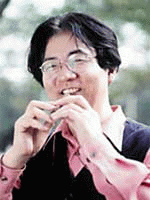
The memory is indelible. My hand is on my friend’s shoulder while I struggle to keep my knees from shaking as the remnants of the Hiroshima hackberry tree become an instrument, and the haunting notes of Amazing Grace fill the banquet room. It is a private concert, composed of an audience of two. We are both literally leaning into the tones— a sound that seems to suspend reality into a moment when all time and suffering and redemption are distilled into the purest strains of music one can imagine.
Listen here.
The soul of Kurotaro consumed every room he entered, and certainly the concert hall, known as “Space Zero,” where the bulk of the P.E.N. presentations unfolded like beautiful, complicated origami. Kurotaro is an unassuming man, and his face will never grace the cover of a celebrity magazine, but that concept is born in American definitions of “culture” and “art” which are bastardizations of truth and beauty.
The International P.E.N. conference has reaffirmed an unexpressed feeling that Americans have been consumed by monotonous “art” that fills the galleries of uncounted seaside tourist traps, music stores, and honky-tonk strips that pollute the vast American coastline and interior lake country resorts. Art in the United States has been reduced to a concept of “Americana” that is self-serving at best and a monetary rip-off at worst. Throw some paint on a canvas, write sloppy music, find an agent or a well-heeled sponsor who thinks they can make a buck, and you are well on your way to American “celebrity” and “artistry.”
Kurotaro’s hackberry tree kokarina supported a literary presentation, “Stones of the Golden Women” at the P.E.N. forum and defined the essence of truth and beauty—the expression of which is the duty of the writer and artist. Fraud, shape shifting, celebrity narcissism, the quest for money, and deception—all have no place in art.
Novelist Khwaiyun Lukjan of Thailand narrated his description of the tsunami of December 26, 2004, when the Adaman Sea devoured the landscape of Thailand in Phang Nga Province on the island of Phuket. The tsunami surged numerous times as set after set of waves ebbed and flowed a distance of over two kilometers inland. Not a building, not a tree survived.
“When people meet with major catastrophe, we throw away the self-image that has been created to protect ourselves in our regular lives and lay bare the self essence residing in the deepest recesses of our hearts,” Lukjan narrated.
“There was only one thing on my mind at the time. To live. No matter what happened I had to overcome it without fail. To survive was the only thing I was thinking about.”
He described himself as “a small ant—drifting in a giant sea,” and from this perspective the story of the “Stones of the Golden Women” was born.
The title of the work describes a devastated Moken Village, Hin Nang Thong, and the quest of a man (Lin) to find the body of his wife and mother of his child, so that he may put her spirit to rest.
The Moken are known as the “people of the sea, or sea gypsies.” Their ancestors arrived in Thailand thousands of years ago from southeastern China, entering the ocean from Indochina. The Moken numbered only 3,000 in the American-dominated tourist areas of Thailand before the tsunami, and their history and culture was literally overrun and ignored. They were truly “an invisible people,” in the words of Lukjan.
The Stones of the Golden Women is a place name that describes a wide stretch of coastline where rocks and stones littered the beach and shellfish were once bountiful in the shallow coastal waters—shallow waters that by their very nature gave lift and power to the tsunami. Shellfish are an important food for the Moken, and Moken women inhabited the beach for this reason. No one standing there survived the 2004 tsunami.
(Note: You can view every article as one long page if you sign up as an Advocate Member, or higher).






