


"Why did so many white rock bands retreat from the ecstatic singing and intense, voicelike guitar tones of the blues, the heavy African downbeat, and the elaborate showmanship that characterized black music of the mid-twentieth century?"
Sasha Frere Jones poses this provocative question in a recent New Yorker article entitled "A Paler Shade of White."
The term indie rock, like the word "blog," is too cozy for comfort. But for convenience's sake, we'll agree to its use. Meanwhile, I can't personally confirm the author's thesis. For some reason, I drifted away from indie rock in the nineties.
Oh wait, I just remembered why: It got too white. In other words, I agree with Jones.
For instance, I found the increased posing and archness of indie rock musicians distancing. In contrast, black music has traditionally sought to make a direct connection with the listener through the emotions.
Worse, for a rhythm freak like myself, the drumming had become too boring. In the past, good white drumming (John Bonham, Keith Moon, Bev Bevan) was the exception to the rule. Indie rock demonstrated little interest in upgrading the situation. It was as if, at peril of being rejected from the genre, a drummer had to promise to keep his use of the 4/4 beat unimaginative.
If one can be said to "outgrow" indie, as well as rock in general, it's less because of the musicians' youthful lyrical concerns (at least in my case) than their failure to keep pace with the listener's expanding rhythm tastes.
Jones suggests that omitting black influences was, in part, a conscious decision by indie rock artists. While mainstream white pop is only too happy to assimilate rap, indie rock musicians shy away from it. The "potential for embarrassment," he writes, "had become a sufficient deterrent for white musicians tempted to emulate their black heroes."
Also, he maintains, they're more conscious of leaving themselves open to charges of minstrelsy. (Jagger has always been kind of Jolson-esque, hasn't he?) This, of course, is to their credit.
But there are three other reasons for the whitewashing to which indie rock has subjected itself.
Musicians who broke out in the sixties, seventies and even eighties listened to blues, soul and jazz. Succeeding generations, however, were less likely to listen to those genres than they were to the wave of indie rock artists immediately preceding theirs. Each decade, black influences thinned out.
Also, after punk and new wave, the art school mentality prevailed and, with it, a taste for the exotic, which is where indie rock musicians turned to assimilate outside influences. Leapfrogging over it to world music, including Africa, was a slap in the face to American black music.
Neither should we forget how disco, which began as black music, left a bad taste in the mouths of many whites. It's odd, though, that the branch of rock that, at first listen, seems the whitest -- electronica -- is actually more steeped in black music than indie rock.
Industrial dance and goa psychedelic trance, both of which I personally favor, are sub-genres of electronica. They derive from disco -- if channeled through a white guy, Giorgio Moroder, who, you may recall, first gained fame producing Donna Summer.
Moroder later became the godfather of techno and electronica by pioneering the use of sequencers. They enabled musicians to generate a trance-like repetition that has become the drug of choice -- even beyond ecstasy and hallucinogens -- for its listeners ever since.
Jones asks: "How did rhythm come to be discounted in an art form that was born as a celebration of rhythm's possibilities?"
I'd like to see his question and raise him. Try replacing his words "art form that" with "black music, which." In other words, his thesis holds equally true for black music as well as white music.
The most popular form of black music today, rap, began life rooted in rhythm. For example, the musicians of the Sugar Hill Gang -- bassist Doug Wimbish, guitarist Skip McDonald and drummer Keith LeBlanc -- were one of the best black bands ever. (They later played with, among others, English producer Adrian Sherwood, the exception to indie rock's bleached bones rule.)
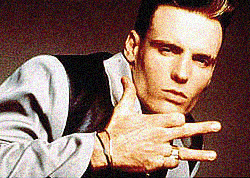
But then came Run-DMC, with their first LP, named after themselves, and its follow-up, "King of Rock." To great crossover success, they incorporated white rock, with its dumbed-down drumming, into their music and rap hasn't been the same since.
This, not the -- attach obligatory "misogynistic" label here -- lyrics is where the root of rap's problem lies. With the bass often as brain-dead as the drum machine programming, rap rhythms tend to be as boring for the serious listener as for the musicians forced to play it. (Commenters: Feel free to contradict.)
In the end, we're left with two questions. . .
Blacks: Why, outside of the neo-soul movement, don't you care about rhythms anymore?
Whites: Why don't you listen to twentieth-century black music anymore?


 66 66
  
Left Behind: Black Music by White Musicians |
|
| Rate It | View Ratings |
Russ Wellen Social Media Pages: 


Russ Wellen is the nuclear deproliferation editor for OpEdNews. He's also on the staffs of Freezerbox and Scholars & Rogues.
"It's hard to tell people not to smoke when you have (more...)
The views expressed herein are the sole responsibility of the author
and do not necessarily reflect those of this website or its editors.




OpEdNews depends upon can't survive without your help.
If you value this article and the work of OpEdNews, please either Donate or Purchase a premium membership.
STAY IN THE KNOW
If you've enjoyed this, sign up for our daily or weekly newsletter to get lots of great progressive content.
If you've enjoyed this, sign up for our daily or weekly newsletter to get lots of great progressive content.
Most Popular Articles by this Author: (View All Most Popular Articles by this Author)
Foxy Knoxy and the Case of the Honorary Missing White Woman
You All Know Hanoi Jane, Now Meet Tehran Todd
What's It Like Waiting Around to Be Bombed?
School, Mall and Workplace Shootings: Why So Many?
Is a Preemptive Strike Ever Justified?
To View Comments or Join the Conversation:
