




On July 2, Angelenos overcame the City-planned divides between rich and poor, cultural differences, and even broke through language barriers in the fight to restore the South Central Farm. When the developer proposed a diesel-spewing warehouse distribution center for the site, Farmers and Farm supporters threw a wrench in the cogs of City Hall and won a round in the fight to force Horowitz to do an Environmental Impact Report: they
forced a twenty-one day delay for more public comments, and gained a glimmer of hope to restore the Farm. The fight between the people and developers' grip on City Hall could be decided by this Wednesday, July 23, 2008, the new deadline for public comments and the second hearing, a week or two later on the tenth floor of City Hall, in front of a small advisory board.
The extension opens the door to reclaim the Farm, but Jan Perry, infamous for running the homeless off her streets, for gentrifying the downtown section of her district while "developing" low-wage strip malls, warehouses, and dead-end jobs for her South Central constituents, is buttressing City Hall's resistance to change. Meanwhile, Farm supporters are back on neighborhood streets. They're making more phone calls. They're carrying petitions to area gatherings and across the country. They're asking Angelenos to send an online petition to the Planning Department, to demand the Recreation and Parks Commission weigh in and protect the adjacent proposed soccer field, to read the MND and the rest of the documents at the South Central Farm website, to offer to help. They're asking the people of Los Angeles to unite once more, to reach out from our urban isolation in defiance of all that conspires to divide us, in order to restore the South Central Farm, the world's largest urban farm, an oasis in the middle of Los Angeles's industrial wasteland.
This is now: Taking on City Hall, 2008Today the South Central Farm is a patch of fertile earth, the sprouts of corn and cactus regularly plowed back into the earth by Horowitz, while he leaves the litter and refuse to clutter the land. But the Farm still lives in the hearts of Angelenos. On July 2, 2008, Farmers, area residents, and their supporters returned to City Hall after a two year hiatus to protest Horowitz's construction of a distribution center on the Farm.
In mid-June, the City noticed the South Central Farm Cultural Center and residents within five hundred feet of the Farm that Horowitz had been issued a mitigated negative declaration, a "neg deco," permitting him to begin construction on a 643,000 square-foot distribution center for an unnamed tenant shaped like an "h," a grotesque monument to development. A neg deco is a declaration by the City Planning Department's that the project would have no adverse environmental impact, that an Environmental Impact Report normally required by the California Environmental Quality Act is unnecessary. From the security of the upper floors of City Hall, the City Planning Department's Deputy Advisory Board had obligingly taken the word of Horowitz's consultants, Terry A. Hayes and Environmental Planning Associates, that Horowitz's monstrous warehouse, capable of transferring cargo from up to 1200 tractor-trailer trucks daily, spewing diesel fumes and traffic into surrounding neighborhoods 24 hours a day, displacing 57,300 cubic yards of earth for a subterranean garage, would have no environmental impact. No effect on human health and safety, no effect on neighborhood noise levels, no effect on possible archeological remains or on the wildlife that still occupies the land, or on the water table below it. City Hall and Perry were at it again, subverting the California Environmental Quality Act, the meaning of Environmental Impact Reports, the point of the 1964 Civil Rights Act's ban on environmental discrimination, all to grease the wheels for developer Horowitz.
Tezozomoc, who, with Rufina Juarez, organized the Farmers to save the Farm in 2003, swore he would stand alone in front of the Deputy Advisory Board's hearing to protect the Farm if he had to. But a week and a few phone calls later, and the South Central Farm Cultural Center was filled with people working out the details of rescuing the Farm, organizing work crews, painting signs and banners, making more phone calls. Residents were canvassed, petitions went up online and out to area events, the media was notified. The fight for the Farm was on, or, as the Farmers had chanted in vigils for two years since the eviction notice, "¡Aquí estamos, y no nos vamos!" Their cry again echoed across the Los Angeles basin.

Two weeks later, on July 2, South Central Farm supporters staged a rally at City Hall and then piled into a hearing room deep in the labyrinth of the bastion of development. There, they defended the Farm, the right to grow food, and the environmental rights of the largely neglected and working-class neighborhood alongside the Farm.
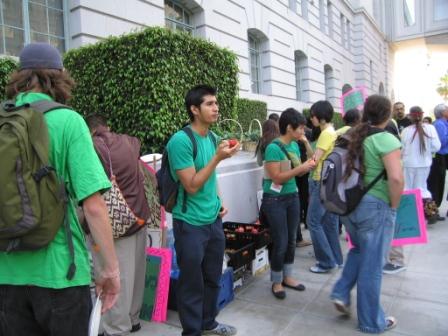
The media flocked to the press conference on the City Hall east lawn. Fifty supporters in SCF T-shirts, brushed off after two years, walked the sidewalk in front of City Hall with banners and signs. A banner was draped over the nearby 110 freeway. The demonstrators chanted, danzantes danced, musicians strummed vihuelas, and car horns gleefully pierced the din of downtown traffic in support. Thirty neighborhood residents and Farmers waited in the tenth-floor hearing room. At ten o'clock, the ralliers joined those upstairs. The crowd mushroomed, spilling out of the 100-seat hearing room into the hallways and an overflow room. City Hall security prowled the sidewalks and the corridors, prepared to keep City Hall secure from the people of Los Angeles.
The Deputy Advisory Board of L.A.'s Planning Department relented even before the first resident spoke. Announcing that the Board would reconsider the MND, she cited the number of letters they had already received. Then she extended the comment period. At that, Rufina Juarez handed the Board new petitions with nearly eight hundred more signatures, and a hundred and forty hand-written letters from Farm neighbors. City Hall shuddered.
The Board had in front of them a letter from the National Resources Defense Council, in which its 1.2 million members demanded a full Environmental Impact Report. In a 21-page analysis, the Center for Biological Diversity noted "the failure [of the Mitigated Negative Declaration] to consider feasible mitigation measures and alternatives to reduce this cumulatively significant impact" and that "the MND cavalierly dismisses Project impacts on global warming." Communities for a Better Environment drafted a report on environmental justice, and the Acequia Institute wrote:
The destruction by bulldozers of the world-acclaimed South Central Farm and eviction of the farmers in July of 2006 marks the most controversial episode in the entire history of urban planning and land use decision-making in the Los Angeles-area. The decision to proceed with the destruction of the farm met with widespread, indeed global, condemnation of an act that displaced a rare and precious cultural and agroecological site of singular importance to the non-governmental and governmental agencies concerned with the future of our local food systems and more sustainable forms of urban inhabitation and land use. . . .
[T]he MND does not even identify environmental justice principles, issues, relevant regulations, and assessment methods. Failing to provide such an analysis means that the proposal, if approved as is, would constitute the most serious and egregious violation of environmental justice principles by LA City and County governments, the Port Authority, land use planning authorities, and other interested parties.
Two dozen speakers for an hour and a half gave life to the experts' testimony. They spoke of noise and the dangers of children crossing traffic. They confronted the Board with the known risks of diesel fumes, of asthma, cancer, emphysema, and underdeveloped lungs in children, that the Board had blithely ignored when they waived an Environmental Impact Report for Horowitz. They testified about living in the backyard of industrialization and dared the Board to do the same. "With this project, we wouldn't have any tranquility day or night," said the first resident to speak. Horowitz's latest consultants, Rosenheim and Associates, a public policy consulting firm trying to establish the inherent industrial character of the neighborhood, had testified that forty-six freight trains and the Blue Line already roared through the neighborhood daily.
She left the table facing the Deputy Advisory Board and walked back to the visitors' seats. Three speakers remained, a couple of them looking nervously at the microphones in front of them. A fourth came up and sat at the vacant seat, waiting her turn.
The next speaker said quietly but firmly, "They should have called us before they did this project, because we have the right as residents to speak of this. We have children, the fumes there are bad for them, people that are sick. I don't think this should be built there."
Tezozomoc cited Title VI of the 1964 Civil Rights Act, the California Environmental Quality Act, and listed the areas frequented by the young, the elderly, and the sick in proximity to the warehouse: Thomas Jefferson High School, Ross Snyder Recreational Center, Metro Vernon Station, the Alameda Swap Meet, Vernon Elementary School, and the City's proposed recreation center and soccer field adjacent to the truck depot.
Then a teacher from Vernon Elementary explained to the Board about learning in industrial desolation: "Some of the challenges faced by students are emissions and pollutants in the air that give off very awful smells and make concentrating on learning very difficult. . . . Every day they are breathing that unhealthy air, and that isn't acceptable. . . .This body should work with the community for what is in the community's best interest, not the developer's. I urge you to deny, deny, deny the developer's plan. No matter how
you design it, it is still another polluting warehouse."
(Note: You can view every article as one long page if you sign up as an Advocate Member, or higher).






