




Not One Dime for Georgia
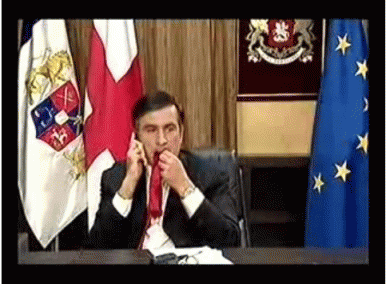
The president of the Republic of Georgia eats his tie on national television. BBC
$1.1 Billion Giveaway for the Republic of Georgia Announced:
"The United States Supports The Recovery, Stability,
And Continued Growth Of Georgia's Economy"
The White House, Sept. 3, 2008
(Wash. DC) We're not talking about the great state of Georgia, which deserves everything it has coming to it and more. We're talking about the Republic of Georgia, a nation of 4.5 million people wedged between Russia and Turkey.
On Wednesday, September 3, the White House announced a comprehensive aid package valued at $1.1 billion dollars to help the Republic of Georgia recover from the whipping it took after it attacked Russian peace keeping forces in South Ossetia, a breakaway province of Georgia near the Russian border. That region experienced a major war in 1991 and varying tensions since.
Russian personnel were in Georgia as part of a multi-national peace keeping regime created by the United Nations and endorsed by the European Union in 2006.
As the Soviet Union dissolved, Georgia declared its independence in April 1991. This resulted in tensions with the Russian government, sparked a civil war, and also generated real concern among those living in South Ossetia. They're not ethnic Georgians and have experienced periodic conflict with the government. As a result of war related violence in 1991, for example, 100,000 fled South Ossetia for refuge and safety in Russia.
South Ossetia held two national elections which endorsed independence form Georgia. The Georgians refuse to recognize this claim and, unlike Kosovo, which had no elections, there was little international support for the aspiring nation. As a result, there have been ongoing skirmishes and political conflicts between the South Ossetia and Georgia from 1991 on.
Georgia is wedged between Russia and Turkey. South Ossetia
is near the middle of the Georgia-Russia border.
WikiCommons
Tensions between Russia and Georgia had been building in recent months. On Aug. 7, 2008, the Georgian president issued orders to his negotiators to meet with the chief Russian negotiator.
(Note: You can view every article as one long page if you sign up as an Advocate Member, or higher).







