







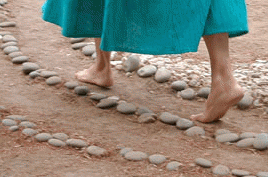
The first Saturday in May has been established as World Labyrinth Day, a global day of celebration of the labyrinth. Falling on May 2 this year, enthusiasts around the globe are invited to "Walk as One at 1" by walking a labyrinth at 1:00 p.m. in local time zones, creating a wave of wellbeing flowing around the world.

Labyrinths differ in design from mazes, and are nearly opposite in function.

A maze has many paths to choose from, some are dead ends, and generally only one path leads to the goal. Making one's way through a maze is a competitive game engaging logic and analytical processes, and is focused on achieving a particular outcome. Because it is a game of skill, a maze usually has walls designed to obscure the view of the correct path.
There are some mazes that have been cut out of cornfields. These are, of course, the Amazing Maize Mazes! (http://www.americanmaze.com/)
In the right brain-left brain model, walking a maze is a left-brain experience.

A labyrinth is unicursal (having only one path), so there are no choices to be made. Therefore, there is no need for walls or hedges to obscure the view, and most labyrinths are flat, or relatively so. Walking the labyrinth is not done to achieve a goal, but in order to have the experience. This type of journey engages the right brain, and is often characterized by right-brain experiences such as contentment, a meditative mood, or a creative, joyful and/or altered state.
The circular rings are called "circuits," and labyrinths may have three or more circuits.
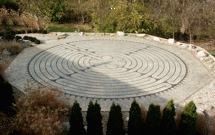
Some people walk the labyrinth slowly, some have crawled it on hands and knees, and others even dance their way through it.
"Research studies conducted in a variety of settings has consistently shown that walking a labyrinth reduces stress. In fact, over the past few years, this has been the most commonly researched topic related to the so-called "labyrinth effect,'" says John W. Rhodes, Ph.D. Chair, Research Committee, The Labyrinth Society (TLS).
TLS is one of the leading groups responsible for promoting the international labyrinth movement. (http://www.labyrinthsociety.org).
One of TLS's greatest contributions has been establishing The World Wide Labyrinth Locator where anyone can go to find public labyrinths that are open to walk. To find a labyrinth near you: http://www.labyrinthlocator.com.

Most people who walk labyrinths report that they simply feel better after their experience. The feelings described range from a state of general well being, to a sense of profound joy, creative bliss, or a connection with Divinity.
In her book, Labyrinths: What are They?, Kay Torrez reports cases of wheelchair-bound MS patients who were eventually able to walk again after regularly using a labyrinth.

Jean Houston and Joseph Campbell were early rediscoverers of the mysteries of the labyrinth, or dromenon, as an archetypal image of the journey of life.
Some think of the labyrinth walk as meditation in motion or kinesthetic prayer.
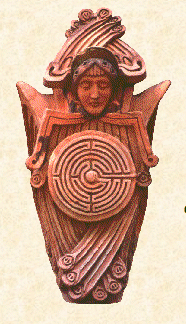
TLS member, Randy Fillmore, has organized a labyrinth walk in Washington, DC, on May 2. A 70' diameter 7-Circuit Classical labyrinth and a 100' diameter 11-Circuit Chartres labyrinth will be constructed on the southeast corner of the Ellipse in front of the White House. Information on labyrinths will be available there.
Events around the country are listed at http://labyrinthsociety.org/events-calendar.
There are different types of labyrinth designs.
Chartres Labyrinths
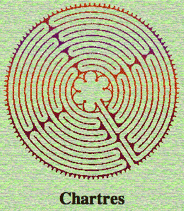
The Chartres style, 11-circuit labyrinth is a medieval design named for the French cathedral in which the most famous example is found.
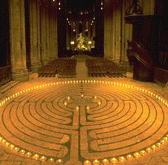
Replicas of it can be found in a number of locations, including one designed for Grace Cathedral in San Francisco by Richard Feather Anderson (http://www.RichardFeatherAnderson.com). Labyrinth Enterprises has created Chartres labyrinth replicas at New Harmony, Indiana, Yanny Heritage Park in Kearny, NE, St. James Cathedral in Chicago, and hundreds of other locations.
Labyrinth Enterprises in St Louis, MO, has the largest canvas labyrinth production studio in the world, 8,000 square feet, enough space for several labyrinths to be in progress.

They also create permanent labyrinth installations made from such materials as stone, wood, tile, pavers, and they have developed a proprietary polymer concrete technique which is cost effective, extremely durable, and low maintenance.

Each labyrinth they create is a unique work of art, custom made to the client's exact personal specifications. Their labyrinths can be found in 48 states and 10 foreign countries.

Robert Ferr????, director of Labyrinth Enterprises, LLC, has worked closely with Veriditas, (http://www.veriditas.org) since the founding of his company in 1995, making the Chartres-style canvas labyrinths which they offer for sale. Labyrinth Enterprises, LLC, is considered by many to be the premier labyrinth production company in the world.
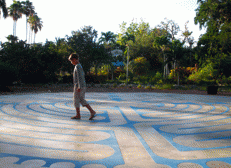
In its first dozen years the company organized four labyrinth conferences, participated in 13 annual labyrinth conferences, produced more than 1,000 labyrinths, "-and consulted, designed, and/or built 60 on-site labyrinths. In addition, during those 12 years over a million people walked the labyrinths"- they designed or created.

Judy Hopen is the vice president, studio manager, production supervisor, director and proprietor of the Labyrinth Enterprises Studio and Canvas Division.
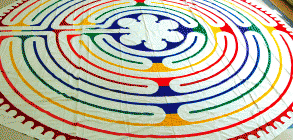
Judy has drawn and painted more than 750 labyrinths -- that's more than anyone in the world, and probably in all of history, making her the world's expert canvas labyrinth creator. I've been lucky to see Judy at work - formerly a model and performance artist, she infuses her craft with joy and beauty.
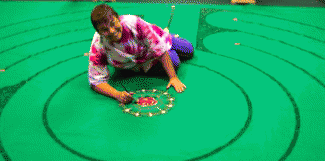
The author painting the Shrine of Holy Wisdom labyrinth. Photo: Trish Schmiedl.
(Image by Meryl Ann Butler) Details DMCA
The 15' x 15' Shrine of Holy Wisdom Rose Labyrinth, was designed and created by the author. The 5-circuit design is based on the central portion of the Chartres labyrinth. It is painted with acrylic paint and glitter on a green heavyweight fabric. Numerologically based upon the numbers three, five and thirteen, the painted lines are embellished with 13 roses, each with five petals in the inner ring, five petals in the outer ring, and three leaves.

A larger red rose in the center is surrounded by twelve glowing stars, repeating the pattern of thirteen within the heart of the labyrinth. It is available for the public to walk at specific times, and available to rent at the Shrine of Holy Wisdom, Tempe, AZ. http://www.christofdivinelife.org
Debi and Marty Kermeen, of Labyrinths in Stone http://www.labyrinthsinstone.com ; make some of the most stunning labyrinths in the world from stone pavers. Their 31' diameter Golden Labyrinth, built in 2007, is located at the Illinois Math and Science Academy for gifted High School students in Aurora IL.

It features a golden mean rectangle in the center, complete with a golden spiral hand cut on site.
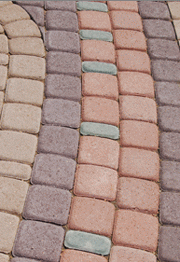
Both the Fibonacci sequence and the prime number sequence are built into the design, creating an interactive math puzzle woven into the labyrinth.
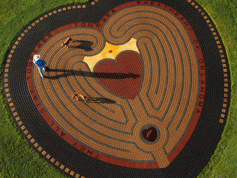
Labyrinths in Stone designed the Tonkawa, OK, Heart in the Park labyrinth in collaboration with labyrinth historian and author, Jeff Saward, of the UK. The heart-shaped labyrinth is surrounded by an historical timeline of the city.

Photographer Ken Crowder says, "Marty and his assistant Jorge Puga, arrived in Tonkawa, and 18 days later, the labyrinth was completed. Marty and Jorge are truly amazing to watch. They don't know the meaning of a day off once they start the construction of a project. Seeing them produce this beautiful labyrinth with such care and meticulous perfection, everyone who comes to see the project, have come away with respect and admiration for what Marty and Jorge have done."
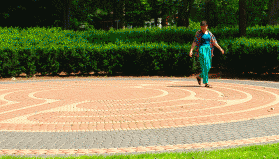
The Kermeens and Saward also collaborated on the labyrinth at The Homestead B & B in Plano, IL. Originally called The Lewis Steward House, it was built in 1854 and is listed on the National Register of Historic Places.

Debi Kermeen of Labyrinth in Stone invites the public to walk a joyful, colorful, Pinwheel Labyrinth Art project at Town Square Park in Yorkville, IL at 1 pm on May 2, designed to create a whirling energy of labyrinth walking as the earth turns. This and other labyrinth activities benefit "Pennies from Heaven," a county-wide campaign to raise money for the local food bank. For more info call 630-553-4350.
Classical/Cretan Labyrinths

The Classical or Cretan style labyrinth is a design found all over the world, as walkable labyrinths, carvings, and on ancient coins from Crete.

A very similar design called "Man in the Maze" is found in traditional Native American culture. This design is believed to be over 4,000 years old.

Judith Joyce (http://www.journeybeyondbelief.com) creates onsite labyrinths for public and private use, in addition to three canvas labyrinths for conference presentations, workshops and ceremonies throughout the United States and abroad.
An interfaith minister, she often performs weddings in a labyrinth such as the one pictured here, a 3-circuit classical labyrinth created for the event. Judith used fall foliage garlands to outline the Classical labyrinth design, and placed pumpkins at the entrance and in the center. Since the Massachusetts couple's favorite season is Autumn, they chose Vermont at peak foliage time for their wedding.
Judith will offer labyrinth walks at the New World Fair at the Pasadena Convention Center, Pasadena, CA, Saturday and Sunday, May 16-17, 2009, and will speak on "Labyrinths: Paths to Peace and Transformation" at 2 pm each day. She will also offer a cancer survivor walk at 3 pm Saturday, and a Walk for World Peace at 3 pm Sunday.
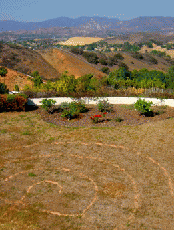
The author's 21-foot diameter, classical seven-circuit bird seed labyrinth was first created on Oct. 31, 2007, to honor the popular Mexican holiday Dios de Los Muertos, the time of the thin veil between this world and beyond. It's been recreated as needed, as weather or aviary celebrants disperse the seed, (Cost: $2.79 for birdseed. Value: Priceless!)


Contemporary Labyrinths

Contemporary labyrinths include original new designs, such as the Santa Rosa Labyrinth and Earthworks labyrinths.

Dr. Lea Goode-Harris holds a Ph. D. in psychology and is the creatrix of the popular Santa Rosa labyrinth design, and founder of the Santa Rosa Labyrinth Foundation. http://www.srlabyrinthfoundation.com

Lea Goode-Harris at the center of the American Psychological Association's Green-Roof Santa Rosa Labyrinth in Washington D.C.

Lea also created the original design for the Snoopy Labyrinth for the Charles M. Schulz Museum and Research Center in Santa Rosa, CA.
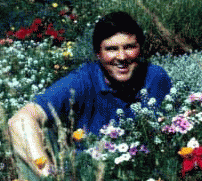
Alex Champion is a scientist, author and dowser with a Ph.D. in biochemistry from UC Berkeley. In 1987 he began designing and building earth labyrinths, three dimensional, walkable labyrinthine designs he calls Earthworks.

He has made over 70 installations representing 30 designs, over the past 13 years throughout the United States, including over 40 Earthworks.

Some of his installations are labyrinthine designs such as the pinwheel design, a labyrinth-maze hybrid, which is painted on a tennis court surface in the middle of a playground in Chinatown, San Francisco, California.
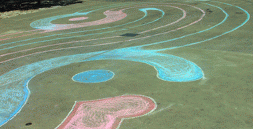
Most of Champion's designs are original, and are based on the primal patterns of Nature, which are often derived through dowsing. http://www.earthsymbols.com
World Labyrinth Day has been established by The Labyrinth Society (TLS) as a day for bringing people from all over the planet together in celebration of the labyrinth as a symbol, a tool, a passion, or a practice. It is designed for informing and educating the public, hosting walks, building permanent and temporary labyrinths, making labyrinth-related art and more. For info about World Labyrinth Day events contact TLS Public Relations Chair, Dr. Stephanie Blackton, 434-466-1505.
The next article in this series is Walk the Pavement to A-Mazement: World Labyrinth Day, May 1 (04.28.10) click here
RESOURCES:

Labyrinths: Ancient Myths & Modern Uses by Sig Lonegren was first published in 1996, one of the only books on the subject at that time. Lonegren has an MA in Sacred Space from Goddard College in Vermont, and is a Trustee of The Labyrinth Society. http://www.geomancy.org

John Ridder's Paxworks is a quiet, custom designer of labyrinths since 1994. Since first walking the labyrinth in 1993, John has created over 150 labyrinths for a variety of clients, including the 2002 Winter Olympics. John is an expert in design and construction of historical and contemporary labyrinths in both natural and man-made media. He says, "Personal attention to each project is extremely important in the way we work!" His award-winning labyrinth at Fatima Retreat House, Indianapolis, was created in 2002 using, stamped, tinted concrete, sandblasting and acid stains. It received the prestigious IRMCA Concrete Design Award. http://www.paxworks.com
The Way of the Labyrinth: A Powerful Meditation for Everyday Life is by Helen Curry, past president of TLS.

Dr. Lauren Artress is the founder and creative director of Veriditas. http://www.veriditas.org The vision of Veriditas is to activate and facilitate the transformation of the human spirit. The work of Veriditas centers around the Labyrinth Experience as a personal practice for healing and growth, a tool for community building, an agent for global peace and a metaphor for life. Dr. Lauren Artress is the author of Walking a Sacred Path: Rediscovering the Labyrinth as a Spiritual Practice. She will host a new internet radio show titled The Wisdom of the Labyrinth beginning May 24th, on Thursdays at 12 noon Pacific time. Dr. Artress is offering a workshop May 1-3 in Rhinebeck, NY, at Omega Institute: Labyrinth Walking: An Ancient Tool for a Whole New Mind. For info: 800-944-1001.

Judith Joyce, owner of Journey Beyond Belief and Certified Conscious Relationship & Body-Mind Vibrance Coach supports individuals and couples in creating a foundation for the future based on what they value using various processes including Coaching, Labyrinths, Dowsing, Reiki and Past Life Regression. With 25+ years as a Corporate Human Resources Executive, she also supports entrepreneurs and small businesses create values-based, innovative workplaces that attract and retain quality employees and build bridges of cooperation and respect between the generations. She can be reached at 928-308-4657; email: jmjoyce@journeybeyondbelief.com; website: http://www.journeybeyondbelief.com.
Jeff and Kimberly Saward are the co-founders and directors of Labyrinthos - the Labyrinth Resource Centre, Photo Library and Archive, and publishers of Caerdroia - the Journal of Mazes and Labyrinths, founded by Jeff in 1980 and and published annually. They were founding members of the Labyrinth Society in 1998 and currently serve on its Board of Directors and as consultants for the society. Based in Thundersley, in Southeast England, they travel extensively to give presentations and research the history and distribution of labyrinths and mazes worldwide. See their website http://www.labyrinthos.net for details of their work, publications, consultancy services, and books.
Dr. Lea Goode-Harris is the creatrix of the popular Santa Rosa labyrinth design, and founder of the Santa Rosa Labyrinth Foundation. http://www.srlabyrinthfoundation.com ; She is a labyrinth designer and creative consultant as well as an artist, poet, and holds a Ph.D. in psychology. She happened upon and walked her first labyrinth in 1993 at the Angela Center in Santa Rosa, California and have been captivated ever since. Lea's life work brings an inquisitive heart to educating, designing, making, and researching labyrinths as well as creating art from a variety of mediums and assisting individuals and groups/businesses in accessing their own creative potential
Founding members of The Labyrinth Society listed in this article include: Taffy Lanser, Kay Torrez, Robert Ferre, Debi and Marty Kermeen, Jeff Saward, Lea Goode-Harris, Judith Joyce, Alex Champion, Sig Lonegren, Helen Post Curry, John Ridder, and the author, Meryl Ann Butler.
 3
3
 2
2
 1
1






