




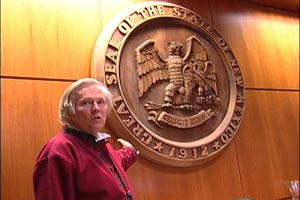

by Stephen Fox, Managing Editor of Santa Fe Sun News
[see also: click here
Not only because of the very valid fears coming from the mad cow syndrome, but because of the nightmarish accumulation of pesticides, antibiotics, steroids, bovine growth hormones manufactured by that corporate monster Monsanto, and other nasty, entirely avoidable chemicals, which in the mainstream American cattle industry are numerous, too many to even begin to mention here....
These biochemical problems are not going to go away, with or without any new trade agreement between the USA and Korea. It defies my comprehension to see that Americans are not out in the streets protesting these chemical horrors and such failed import policies, as so commendably are the Koreans, especially those protesting in Seoul. Americans have grown very fat and acquiescent, I regret to say, indifferent as to what is obviously destroying their own health.
Therefore, I strongly encourage Koreans not to "drop the ball" and give up in their concerns and demands to not import American beef, but also please not to assume that beef from other nations is going to be any better,
particularly if it is from China, with its dreadful recent record in terms of shoddy consumer protection, deadly chemicals, and substandard food production, in which chemicals are substituted solely because they can pass
inspection and might save the producer a few fractions of
a yuan!
After World War II, U.S. farmers and food production rapidly devolved away from natural growing methods to entirely rely on chemicals to improve production yields. This was initially viewed as a positive move, but the
long-range effects on the land and its fertility began to show up with accelerating alarm, including topsoil depletion, groundwater pollution, and the collapse of many family farms for reasons of lost fertility and failure
to compete economically.
I am reminded strongly of how Monosodium Glutamate entered the US food supply. Japanese soldiers retreating from South Pacific islands left behind tins of rations, and American soldiers consumed them, not knowing that they had been heavily laced with Monosodium Glutamate, a chemical found in particular seaweeds used to enhance the flavor in soup, which was isolated at Tokyo Imperial University by Dr. Kikunae Ikeda in 1908 then manufactured heavily over the next 30 years in Japan.
These American soldiers raved about how wonderful and tasty was this "military food," perhaps tasting better than anything they got through the US Quartermaster, the official in charge of all American rations of military food, among other responsibilities. So after the War, the US Quartermaster in 1948 convened a meeting at the Stevens Hotel in Chicago with the top CEO's, Chairmen, and Presidents of the largest American food corporations, including Borden's Milk, Campbell's Soups, General Mills, General Foods, and Hershey's Chocolates.
The Quartermaster extolled the virtues of tasty foods samples prepared with MSG, served to the corporate representatives, none of whom had ever tried or used MSG in their products. They adopted it whole hog and enthusiastically, with almost no research or testing on its neurotoxic and neurodegenrative effects, all of which became extremely clear over the next few decades, yet still remain in most US manufactured food products (a kind of slow karmic and biochemical revenge for the bombings at Hiroshima and Nagasaki?), and still very present in most Japanese and Chinese food product exports.
The world's largest manufacturer of this neurotoxic and neurodegenerative food additive is Ajinomoto ('essence of taste') of Japan, which is also the world's largest manufacturer of another proven neurotoxin, the artificial
sweetener, Aspartame. In order to deflect criticism and to further promote their products, this corporation and other related henchmen corporations using their additives, like Coca Cola and Pepsi Cola, have formed very powerful food lobbyist groups.
With clock-like predictability, these lobbyists fly into high gear when any consumer protection groups introduce legislation at the state level any where in the United States. The most powerful in the US is called the Glutamate Association of the United States, and another is called "Calorie Control Council," a cute catchy name for some of the more malevolent corporate spin doctors in the United States, in my opinion and in my experience.
I know all of this from personal experience here in New Mexico. If things begin to look tough for them from an administrative or regulatory point of view, like when a Health Board or, as we have here in New Mexico, the
Environmental Improvement Board, might begin to question or make rules prohibiting MSG or another proven carcinogen, Aspartame, they threaten the board with lawsuits, thus causing the mousy Board Members to roll over, play dead, and cancel the hearing permanently....
When the action in New Mexico then shifted to a legislative context and bills-to-ban were introduced, thanks to the most progressive member of the New Mexico Legislature, Senator Gerald Ortiz y Pino, these corporations' lobbyists pulled out all of the stops, leaning on their legislative pals and cronies, making campaign contributions and giving them and their friends
lavish parties, and at the same time, dumping on the opponents of their products by impugning what they called "Internet Junk Science."
(I am sure things just like this happen in Korea and in every single other nation! Pathetic and nauseating, isn't it?)
They also did this in Hawaii in the 2008 Legislative session for just a simple Resolution to simply ask the FDA Commissioner to rescind the approval for Aspartame, sponsored by the most consumer protection minded member of
the Hawaii Legislature, Senator Suzanne Chun-Oakland and signed by 44% of the Hawaii Senators as cosponsors.
Fortunately, both New Mexico Senator Ortiz y Pino and Hawaii Senator Chun-Oakland will resume their efforts in 2009, rather than abandon them due to pressure from mere corporate lobbyists.
On the national and international scale, many Americans are beginning to comprehend that President Barack Obama will appoint the next Commissioner of the United States Food and Drug Administration to replace the corporate-serving lackey presently there (Dr. Andrew Von Eschenbach, an oncologist and cancer survivor himself, who should know better, or at least pretend to know better, who most certainly will be gone in less than four months). This FDA appointment will become one of the most important of Obama's appointments, excepting considerations of who will be appointed as the next Secretary of State and the next United States Attorney General, to hopefully begin repairing the damage done over the last 8 years....
Concerning poisons found in American beef, in the mid 1960s, about the time Rachel Carson's influential book, Silent Spring, began to have a massive impact on the popular consciousness, a tiny minority of Americans began to recognize harmful effects from industrialized agriculture policy, and a very few of this tiny minority decided to return to a healthier growing of food.
After almost 40 years, the organic movement has evolved from being considered a lunatic fringe group, continually criticized for their zealousness by mainstream media articles planted by the corporations involved. Now the
organic movement has become a major niche in the mainstream marketplace.
According to USDA rules passed on October 22, 2002, certified organic beef must come from a fully verifiable production system that collects information on the history of every animal in the program, including breed history, veterinary care and related injections, and feed. Furthermore, in order to be certified as organic, all cattle must meet the following criteria:
Born and raised on certified organic pasture
Never receive antibiotics
Never receive growth-promoting hormones
Are fed only certified organic grains and grasses
Must have unrestricted outdoor access
Must receive humane treatment
With the advent of the Organic label, people wrongly assumed that "organic" and "natural" were interchangeable, not comprehending the strict regulations required to raise certified organic beef. The USDA defines "natural" beef as all meats raised for human consumption without additives and minimally processed. Natural Beef producers may choose not to use antibiotics or growth-promoting hormones, but there is no third-party verification system required by the USDA. Beef from huge factory feed lots can be labeled natural, according to the USDA's definition.
Certified organic beef implies much more than a promise not to use antibiotics or growth-promoting hormones. It is a verifiable system for beef production, to improve the land and the lives of the animals raised for food by preventing their consumption of potentially harmful and incontrovertibly toxic man-made chemicals offering cost-saving shortcuts at the expense of the environment and the health of the people who enjoy eating beef. Confined living conditions are forbidden.
As organic cattle approach the weight at which they will be slaughtered and sold, two feeding methods are used which deliver beef products to their end-users and consumers, grass-Fed and grain-Fed.
In the grass-fed program, the cattle eat certified organic grass right up to the time of harvesting. The USDA is developing guidelines defining "Grass-Fed," eventually to call for an all grass diet of at least 95%.
Among the first certified organic grass-fed beef companies was Mesquite Organic Foods, which is based out of Colorado. Founder Dr. Steve Atchley is also a cardiologist who knew that his patients needed a source of leaner
beef to protect their hearts' health. Strictly grass-fed cattle tend to be leaner and to some, less flavorful than grain-fed.
Grain finishing is far more usual in the cattle industry because it produces to many consumers more flavorful cattle with a higher percentage of fat.
All grains must be certified organic to protect the integrity of the program. Dakota Beef 100% Organic is an industry-leading example of this type of operation. Headquartered in Howard, South Dakota, the company is the
largest organic beef producer in the nation. By micromanaging every single step through all phases of production, all cattle are demonstrably in compliance with the National Organic Program throughout their lives. It has developed a grain-based feeding formula to deliver a well-marbled product that most consumers prefer.
A few American beef producers are expanding into the organic beef niche by importing boxed beef from South America. While this is just barely acceptable within the National Organic Program's rules, it does not follow the spirit of the American organic movement. To make way for more pasture to raise cattle, great swaths of South American rain forest have been clear-cut. Additionally, the ecological advantage of raising cattle on clean land
without added chemical inputs in their feed is greatly diluted when the beef is shipped anywhere from 5,000 to 10,000 miles to reach American markets.
Time will tell in all of this as the future of consumer protection efforts won't be revealed right away. It is a real shame that both many Koreans and what few Americans seems to be concerned have to spend so much energy, time,
and money, in order to make what should be clear points of logic and law about health, longevity, and foods which are not obviously harmful, instead of fighting with mega corporate interests that control the government officials and regulatory agencies which are supposed to be acting on our behalf.
Stephen Fox
Managing Editor, Santa Fe Sun News
Founder, New Millennium Fine Art Gallery, since 1980
[see also: click here
Not only because of the very valid fears coming from the mad cow syndrome, but because of the nightmarish accumulation of pesticides, antibiotics, steroids, bovine growth hormones manufactured by that corporate monster Monsanto, and other nasty, entirely avoidable chemicals, which in the mainstream American cattle industry are numerous, too many to even begin to mention here....
These biochemical problems are not going to go away, with or without any new trade agreement between the USA and Korea. It defies my comprehension to see that Americans are not out in the streets protesting these chemical horrors and such failed import policies, as so commendably are the Koreans, especially those protesting in Seoul. Americans have grown very fat and acquiescent, I regret to say, indifferent as to what is obviously destroying their own health.
Therefore, I strongly encourage Koreans not to "drop the ball" and give up in their concerns and demands to not import American beef, but also please not to assume that beef from other nations is going to be any better,
particularly if it is from China, with its dreadful recent record in terms of shoddy consumer protection, deadly chemicals, and substandard food production, in which chemicals are substituted solely because they can pass
inspection and might save the producer a few fractions of
a yuan!
After World War II, U.S. farmers and food production rapidly devolved away from natural growing methods to entirely rely on chemicals to improve production yields. This was initially viewed as a positive move, but the
long-range effects on the land and its fertility began to show up with accelerating alarm, including topsoil depletion, groundwater pollution, and the collapse of many family farms for reasons of lost fertility and failure
to compete economically.
I am reminded strongly of how Monosodium Glutamate entered the US food supply. Japanese soldiers retreating from South Pacific islands left behind tins of rations, and American soldiers consumed them, not knowing that they had been heavily laced with Monosodium Glutamate, a chemical found in particular seaweeds used to enhance the flavor in soup, which was isolated at Tokyo Imperial University by Dr. Kikunae Ikeda in 1908 then manufactured heavily over the next 30 years in Japan.
These American soldiers raved about how wonderful and tasty was this "military food," perhaps tasting better than anything they got through the US Quartermaster, the official in charge of all American rations of military food, among other responsibilities. So after the War, the US Quartermaster in 1948 convened a meeting at the Stevens Hotel in Chicago with the top CEO's, Chairmen, and Presidents of the largest American food corporations, including Borden's Milk, Campbell's Soups, General Mills, General Foods, and Hershey's Chocolates.
The Quartermaster extolled the virtues of tasty foods samples prepared with MSG, served to the corporate representatives, none of whom had ever tried or used MSG in their products. They adopted it whole hog and enthusiastically, with almost no research or testing on its neurotoxic and neurodegenrative effects, all of which became extremely clear over the next few decades, yet still remain in most US manufactured food products (a kind of slow karmic and biochemical revenge for the bombings at Hiroshima and Nagasaki?), and still very present in most Japanese and Chinese food product exports.
The world's largest manufacturer of this neurotoxic and neurodegenerative food additive is Ajinomoto ('essence of taste') of Japan, which is also the world's largest manufacturer of another proven neurotoxin, the artificial
sweetener, Aspartame. In order to deflect criticism and to further promote their products, this corporation and other related henchmen corporations using their additives, like Coca Cola and Pepsi Cola, have formed very powerful food lobbyist groups.
With clock-like predictability, these lobbyists fly into high gear when any consumer protection groups introduce legislation at the state level any where in the United States. The most powerful in the US is called the Glutamate Association of the United States, and another is called "Calorie Control Council," a cute catchy name for some of the more malevolent corporate spin doctors in the United States, in my opinion and in my experience.
I know all of this from personal experience here in New Mexico. If things begin to look tough for them from an administrative or regulatory point of view, like when a Health Board or, as we have here in New Mexico, the
Environmental Improvement Board, might begin to question or make rules prohibiting MSG or another proven carcinogen, Aspartame, they threaten the board with lawsuits, thus causing the mousy Board Members to roll over, play dead, and cancel the hearing permanently....
When the action in New Mexico then shifted to a legislative context and bills-to-ban were introduced, thanks to the most progressive member of the New Mexico Legislature, Senator Gerald Ortiz y Pino, these corporations' lobbyists pulled out all of the stops, leaning on their legislative pals and cronies, making campaign contributions and giving them and their friends
lavish parties, and at the same time, dumping on the opponents of their products by impugning what they called "Internet Junk Science."
(I am sure things just like this happen in Korea and in every single other nation! Pathetic and nauseating, isn't it?)
They also did this in Hawaii in the 2008 Legislative session for just a simple Resolution to simply ask the FDA Commissioner to rescind the approval for Aspartame, sponsored by the most consumer protection minded member of
the Hawaii Legislature, Senator Suzanne Chun-Oakland and signed by 44% of the Hawaii Senators as cosponsors.
Fortunately, both New Mexico Senator Ortiz y Pino and Hawaii Senator Chun-Oakland will resume their efforts in 2009, rather than abandon them due to pressure from mere corporate lobbyists.
On the national and international scale, many Americans are beginning to comprehend that President Barack Obama will appoint the next Commissioner of the United States Food and Drug Administration to replace the corporate-serving lackey presently there (Dr. Andrew Von Eschenbach, an oncologist and cancer survivor himself, who should know better, or at least pretend to know better, who most certainly will be gone in less than four months). This FDA appointment will become one of the most important of Obama's appointments, excepting considerations of who will be appointed as the next Secretary of State and the next United States Attorney General, to hopefully begin repairing the damage done over the last 8 years....
Concerning poisons found in American beef, in the mid 1960s, about the time Rachel Carson's influential book, Silent Spring, began to have a massive impact on the popular consciousness, a tiny minority of Americans began to recognize harmful effects from industrialized agriculture policy, and a very few of this tiny minority decided to return to a healthier growing of food.
After almost 40 years, the organic movement has evolved from being considered a lunatic fringe group, continually criticized for their zealousness by mainstream media articles planted by the corporations involved. Now the
organic movement has become a major niche in the mainstream marketplace.
According to USDA rules passed on October 22, 2002, certified organic beef must come from a fully verifiable production system that collects information on the history of every animal in the program, including breed history, veterinary care and related injections, and feed. Furthermore, in order to be certified as organic, all cattle must meet the following criteria:
Born and raised on certified organic pasture
Never receive antibiotics
Never receive growth-promoting hormones
Are fed only certified organic grains and grasses
Must have unrestricted outdoor access
Must receive humane treatment
With the advent of the Organic label, people wrongly assumed that "organic" and "natural" were interchangeable, not comprehending the strict regulations required to raise certified organic beef. The USDA defines "natural" beef as all meats raised for human consumption without additives and minimally processed. Natural Beef producers may choose not to use antibiotics or growth-promoting hormones, but there is no third-party verification system required by the USDA. Beef from huge factory feed lots can be labeled natural, according to the USDA's definition.
Certified organic beef implies much more than a promise not to use antibiotics or growth-promoting hormones. It is a verifiable system for beef production, to improve the land and the lives of the animals raised for food by preventing their consumption of potentially harmful and incontrovertibly toxic man-made chemicals offering cost-saving shortcuts at the expense of the environment and the health of the people who enjoy eating beef. Confined living conditions are forbidden.
As organic cattle approach the weight at which they will be slaughtered and sold, two feeding methods are used which deliver beef products to their end-users and consumers, grass-Fed and grain-Fed.
In the grass-fed program, the cattle eat certified organic grass right up to the time of harvesting. The USDA is developing guidelines defining "Grass-Fed," eventually to call for an all grass diet of at least 95%.
Among the first certified organic grass-fed beef companies was Mesquite Organic Foods, which is based out of Colorado. Founder Dr. Steve Atchley is also a cardiologist who knew that his patients needed a source of leaner
beef to protect their hearts' health. Strictly grass-fed cattle tend to be leaner and to some, less flavorful than grain-fed.
Grain finishing is far more usual in the cattle industry because it produces to many consumers more flavorful cattle with a higher percentage of fat.
All grains must be certified organic to protect the integrity of the program. Dakota Beef 100% Organic is an industry-leading example of this type of operation. Headquartered in Howard, South Dakota, the company is the
largest organic beef producer in the nation. By micromanaging every single step through all phases of production, all cattle are demonstrably in compliance with the National Organic Program throughout their lives. It has developed a grain-based feeding formula to deliver a well-marbled product that most consumers prefer.
A few American beef producers are expanding into the organic beef niche by importing boxed beef from South America. While this is just barely acceptable within the National Organic Program's rules, it does not follow the spirit of the American organic movement. To make way for more pasture to raise cattle, great swaths of South American rain forest have been clear-cut. Additionally, the ecological advantage of raising cattle on clean land
without added chemical inputs in their feed is greatly diluted when the beef is shipped anywhere from 5,000 to 10,000 miles to reach American markets.
Time will tell in all of this as the future of consumer protection efforts won't be revealed right away. It is a real shame that both many Koreans and what few Americans seems to be concerned have to spend so much energy, time,
and money, in order to make what should be clear points of logic and law about health, longevity, and foods which are not obviously harmful, instead of fighting with mega corporate interests that control the government officials and regulatory agencies which are supposed to be acting on our behalf.
Stephen Fox
Managing Editor, Santa Fe Sun News
Founder, New Millennium Fine Art Gallery, since 1980






