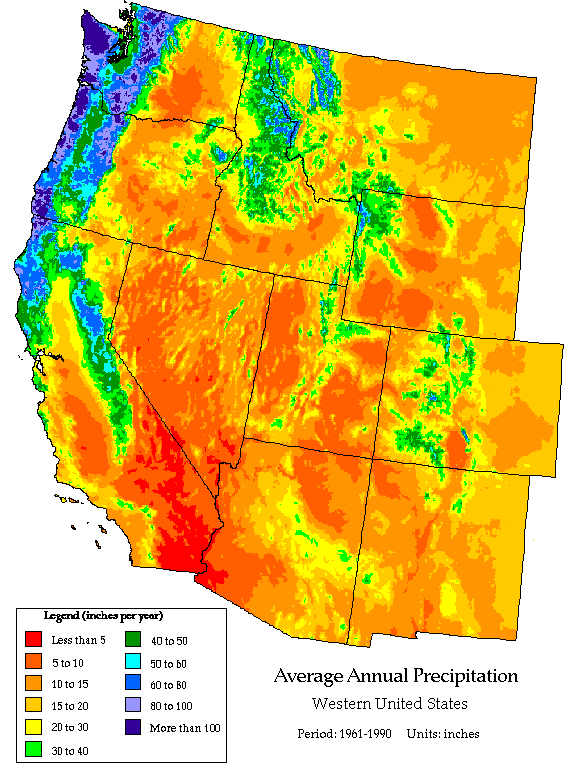
It's said our primeval ancestors had a simple arithmetic system: "One, two, three, many". That describes the focus of many 2008 voters, whose concerns are the economy, energy prices, Iraq, and "those other problems." As we get closer to the presidential election, most Americans aren't worried about global warming. Maybe they will be when they turn the tap and no water comes out.
In early August we toured Glacier National Park with the Sierra Club, catching a glimpse of several of the humongous ice fields. In 1910 there were 150 glaciers in the park; now there are 25, which are losing 9 percent of their mass per year. Sometime between 2015 and 2020 they'll disappear. Locals joke the 1.4 million acres will be renamed "Puddles National Park."
Worldwide, most glaciers are diminishing. So is the ice pack in places like the North Pole and Iceland. While ice loss is generally regarded as compelling evidence of global warming, most Americans aren't losing any sleep over it. An April Gallup Poll found that "while 61% of Americans say the effects of global warming have already begun," only 37 percent are worried about it, roughly the same percentage that were concerned when Gallup first began asking the same question, nineteen years ago.
Why isn't global climate change seen as a more important issue?
Many observers believe the typical American is too busy to be bothered by more than a couple of national problems – it's the "one, two, three, many" phenomenon. Social scientists report that average voters don't have a lot of leisure time; they're too busy struggling to make ends meet. Most Americans are worried about the economy – paying their mortgage and health insurance – and gasoline prices. The little news most of us have access to either comes from talk radio – cultural issues – or cable TV – Iraq and terrorism. While we're aware of the threat posed by global climate change, we're too harried to be able to consider the consequences.
Unless it slaps them in the face, the typical American can't be bothered by an abstract threat. If there's a global warming event – a mammoth hurricane, tornado, or forest fire – in our neighborhood, then we get concerned. From this perspective, the loss of a few thousand acres of ice in a remote corner of Montana hardly seems significant. Most of us don't see it as a danger sign.
But it is. Disappearing glaciers is a harbinger of huge problems. In the West, the most obvious is drought.
During our tour of Glacier Park, local scientists explained the systemic effects of global warming. In addition to glacier melt there is less snow, more rain, and longer growing seasons. Over the past fifty years the average Montana temperature has risen six degrees Fahrenheit. This has caused longer dry periods, which have resulted in a massive loss of timber due to an infestation by the Mountain Pine Bark Beetle. This in turn, has fed catastrophic forest fires – like hurricanes and tornadoes, it's not that these disasters happen more frequently, but that when they do they have greater impact. Warmer water coupled with loss of foliage threatens much of Glacier's wildlife. And, Montana's stream flow is decreasing; a state that used to have an abundance of water now has areas that don't have enough: eastern Montana suffers from a prolonged drought and last year Montana filed suit against Wyoming arguing the state was taking more than its fair share of water from the Yellowstone river.
If you live in an area with lots of water, you probably don't care about the west's water problems. But out here on the left coast, drought is an ominous fact of life. As the southwest was populated – an area stretching from Los Angeles to Albuquerque – water had to be transported from the north, because annual rainfall wasn't sufficient to supply local needs. The water problems in Montana illustrate an ominous reality for the west: global warming is reducing our regional water supply. If you live in the Los Angles basin, most of your water comes from the Owens River in the Sierras and the Colorado River; both are diminishing.
As the name suggests, the Colorado River is fed by Colorado mountain snow melt, which has dramatically decreased in the past few years. The 1400-mile-long river is the primary water supply for seven states. By 2012, due to increased demand and diminished supply, the Colorado River will no longer be able to meet it's contractual commitments. Meanwhile, there are signs of impending disaster all along the watercourse: Lake Powell has already gone dry and experts predict that Lake Mead will be disappear by 2021.
If Montana, a state with a population of one million, is beginning to run out of water, what does this suggest lies ahead for Southern California, an area inhabited by 23 million? Citizens of the southwest may have other concerns today, but at the end of the decade their collective cry will be show me the water!
Bob Burnett is a Berkeley writer and Quaker actvist. He is particularly interested in progressive morality and writes frequently on the ethical aspects of political and social issues.
I am concerned about global warming because it causes a lot of hardship. However, the big question I have is, is it man-made or is it cause by the sun? There are scientific reports that show other planets in our solar system are also warming up. If that is the case, it could be due to the sun. Unless other planets in our solar system have lifeforms that drive cars and run factories. Global warming might have more to do with the solar cycle than anyting else. http://science.nasa.gov/headlines/y2008/10jan_solarcycle24.htm
If it is the solar cycle that is causing the earth to warm, there isn't much we can do about it. Although I believe conservation is very important, I am against any new taxes consumers would have to pay. This could be another scam by those in power to pocket the money. No fearmongering and no carbon tax. Let's look at all the evidence.
Go
by
Goblue (0 articles, 0 quicklinks, 0 diaries, 50 comments)
on Thursday, August 14, 2008 at 9:59:06 AM
There are several solar cycles. The 11-year one you mention doesn't account for the trends we see with current records nor with fossil records. There are however possible 100,000+ year cycles which have connection to climate changes of the past.
Currently, we do not have full understanding of all the interconnections that produce climate change. However, we do have evidence that human inputs have increased current levels of greenhouse gases. We do have evidence that we are having detrimental effects on habitats.
Doesn't prudence dictate that we should modify our behavior? Is there some reason that reducing our impact is a bad strategy? Are there really significant reasons not to consider our future impact on the planet and providing the most viable living style for humanity?
What are the issues? Isn't our future dependant on our learning to adjust and maintaining our habitat? The planet will continue no matter what. It's humanity that may be disturbed at the form the future takes. But there will always be some organism that takes advantage of change, adapts faster and better, and has the advantage.
If there is a purpose to the universe, maybe change is the purpose of climate change. It's happened in the past and massive changes occurred. Perhaps we have reach the extent of our ability to adapt. Time to move on?
I am not trying to be simplistic, but with such complex systems, what is the harm of erring on the positive ???
by
sometimes blinded (2 articles, 81 quicklinks, 9 diaries, 308 comments)
on Thursday, August 14, 2008 at 10:37:28 AM
As a progressive and an open minded person, I am all for conservation and I stated that in my first post. However, if world leaders want to levy taxes, I would be very skeptical and would oppose it. One of the main people behing this global warming scare is a Rockafellar. Rather than using taxes, people of the world should be encourage to use althernative energies, not pollute and conserve. Mainly in the U.S. since other countries are years ahead of us. Let's use some common sense before we tax the people of the world trillions of dollars.
I recently attended a Q & A session where a noble prize winning scientist from the University of Montana (Running) was asked the question about GW causes. He said it is NOT caused by the sun's activity, it is man made
by
Bob Burnett (198 articles, 0 quicklinks, 0 diaries, 1 comments)
on Thursday, August 14, 2008 at 12:32:14 PM
What I would like to know is what is causing the other planets in our solar system to warm up? It can't be man-made. If we can answer this question, we might know what is causing the earth to warm up. I believe it is a reasonable question to ask and a convincing answer needed before we start taxing every man, women and child in the world.
Why are we debating on the causes of climate change? It's here and it's happening and we need to act not argue. Oil is dirty and finite and burning it makes the air nastyand smelly. Same for coal and other fossil fuels. Using renewable energy such as wind and solar is a no brainer. It would create lots of skilled jobs that we desperately need and maybe I could breathe again without wheezing. Also maybe the elastic in my clothes would stop rotting from the chemicals in the air and I wouldn't have to throw away my favorite shorts.
by
macdon1 (0 articles, 0 quicklinks, 0 diaries, 106 comments)
on Thursday, August 14, 2008 at 7:03:31 PM
...And here we have mega-Billionaires like T.Boone Pickins trying to take over the Ogalallah Sioux reservoir, the nations' biggest water cache, through his wealth and vile trickery, making it sound like he's doing a Goody two shoes job for us with Windpower!
by
Bia Winter (4 articles, 0 quicklinks, 11 diaries, 456 comments)
on Friday, August 15, 2008 at 8:18:37 AM
9 comments
How would you rate this?
You must be logged in (if signed up) to do ratings.
It's free to signup! And easy. And takes just a minute or two....