

Tag(s): ; ; ; ; ; ; ; ; ; ; (more...) ; ; ; ; ; , Add Tags  (less...)
Add to My Group(s)

View Ratings | Rate It

Promoted to Headline (H3) on 7/14/10:     Permalink
View Article Stats

Giving Your Child Real, Life-long Survival Skills: Verbal First Aid

Add this Page to Facebook!
Submit to Twitter
Submit to Reddit
Submit to Stumble Upon

Tell A Friend

Become a Fan
Get Embed HTML Code
By (about the author)

Become a Fan Become a Fan  (6 fans)   -- Page 1 of 2 page(s)

opednews.com

PART II, continued from 7/12/10

Children and Hardwiring

Children develop working models of the world in their minds as they develop. This starts at birth. Emotional memories and experiences are formed into templates and stored in the right hemisphere of the brain. These templates then begin to form impressions of the world that determine how we respond to any given situation.

If children have been given calm, authoritative guidance and love, they see the world as safe.
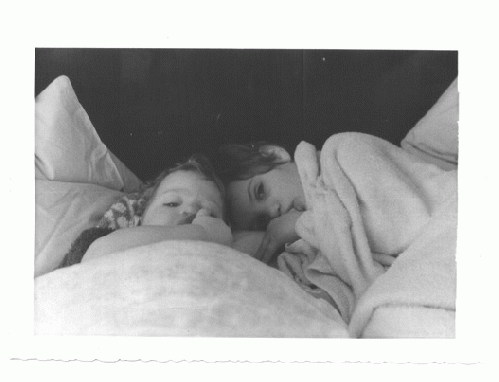

Safe Babies and Verbal First Aid by Judith Acosta

If children have been abandoned to their own devices prematurely, they fail to integrate their perceptions properly and see the world as unsafe.

As Sibcy and other Attachment theorists claim, every child from birth is in a constant state of assessment: Am I safe? This is the question that must be answered and IS answered by his or her experience.

What do parents want for their children?

They want them to be healthy, resourceful, and adaptable. They want them to be able to reason on their own, respond to challenges as they come up, and enjoy full, meaningful lives.

What does Verbal First Aid teach children?

By using words to facilitate a different perception and a blending of cortical and limbic functions of the brain, we are teaching our children self-healing, self-regulation, cognitive modification, the ability to relax and focus in crisis, as well as ahealthy self-reliance when things get tough.

How can parents do this with Verbal First Aid?

According to medical experts, anxiety (or fear) and pain are inextricably woven together for the vast majority of people. A great deal of human discomfort comes from our anticipation of it and our perception of it. Unfortunately, there is nothing marketed as vigorously in this country as is fear. If we're not scared to death by a headline, it's a radio report, a movie, a video game, or a television show. We're literally bombarded by images and ideas that promote fear. We are propelled by it and sold by it.

Children are even more at risk, since they don' t yet have the cognitive apparatus to separate what is true and what is not, what is being used as a sales tool or a ratings booster (usually shock, scandal and fear) and what is genuinely something to prepare for.

If the science is correct, the good news is that we can change our response on every level--from the conscious to the autonomic. When we alter our thoughts, are soothed by a kind authority, or are assured that we are in good hands, we can begin to feel the changes in our bodies--the softening of muscle fiber, the opening of bronchial tubes, the quieting of pain, the start of healing.

This is why so much of Verbal First Aid is directed to the alleviation of anxiety through the development and utilization of rapport. In rapport, a person will feel, "She understands me." "He is going to help me." "I'm safe, now." When we are speaking to children, this safety is even more vital because their brains are developing not only in experience but in integrative faculties. This means that when they are feeling frightened or hurt and someone is there to 1) help them, 2) take charge benevolently, 3) make them feel secure, and 4) teach them what to do with the sensations and emotions they are experiencing. This last one--which integrates thinking and feeling--is a lifelong resource. It is what enables them to be resourceful, adaptable and healthy.

Next Page  1  |  2


Judith Acosta is a licensed psychotherapist, author, and speaker. She is also a classical homeopath based in New Mexico. She is the author of The Next Osama (2010), co-author of The Worst is Over (2002), the newly released Verbal First Aid (more...)
 

The views expressed in this article are the sole responsibility of the author
and do not necessarily reflect those of this website or its editors.

Contact Author Contact Editor View Authors' Articles

Follow Me on Twitter


Share this page: (what's this?)                   Tell a Friend: Tell A Friend

Add this Page to Facebook!      Submit to Stumble Upon      Submit to Reddit      Add This Page to Mr Wong!           NEWSVINE      DEl.ICIO.US      Looksmart Furl      My Web      Blink List     (More...)

Comments

The time limit for entering new comments on this article has expired.

This limit can be removed. Our paid membership program is designed to give you many benefits, such as removing this time limit. To learn more, please click here.

Comments: Expand   Shrink   Hide  
No comments

