




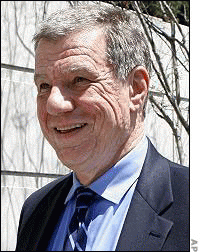
A noted Hollywood filmmaker, above, faces prison after a conditional guilty plea July 12 in a wiretapping case so interesting that it deserves two alternative news accounts.
Here's a version that Reuters provided to news organizations serving a vast majority of Americans:
"Die Hard" film director John McTiernan pleaded guilty to lying to law enforcement officials in connection with the racketeering case of a private detective who represented many Hollywood stars.
A trial for McTiernan had been expected to begin on Tuesday in Los Angeles on two counts of making false statements to federal agents and one count of perjury. McTiernan, 59, originally pleaded guilty in 2006 to a charge of knowingly lying to agents of the Federal Bureau of Investigation in the criminal case against private detective Anthony Pellicano, who has since been jailed.
But the film director later withdrew his plea, saying he had received poor legal advice, had been drinking and was jet-lagged from traveling when FBI agents questioned him. Federal officials again charged McTiernan with crimes in 2009, leading to Monday's guilty plea. A judge set a sentencing date of Oct. 4....
I've written at least a hundred variants of this kind of traditional guilty plea story while covering federal courts fulltime from 1976 to 1980 for the Hartford Courant, Connecticut's largest paper. But times have changed, and IMO the essence of McTiernan's case is better conveyed this way:
Yet again, federal authorities abused their powers by creating a crime that ruined a defendant's career, at needless expense to taxpayers.
Too tough a verdict? You be the judge.
But first, McTiernan's plea was "conditional" on the results of his appeal. This important point was totally omitted by the Reuters story and thus by such headlines around the nation as that by the July 13 Washington Post, which blares out to its readers: "John McTiernan is headed to jail."
Wiretappers Unmasked
In 2002, a federal investigative team led by Assistant U.S. Attorney Daniel Saunders and FBI agent Stanley Ornellas exposed a scheme whereby the famous LA private eye Pellicano, below, systematically broke wiretapping laws to help his clients in big-dollar entertainment industry battles.
In 2004, Howard Blum and John Connolly authored an in-depth overview for Vanity Fair entitled, "The Pellicano Brief." It described Pellicano's "A-list" clients and a pivotal raid of the detective's offices by the feds, who seized guns, $200,000 in cash, plastic explosives and hand grenades on their way to winning a 15-year prison term for the tough-talking PI, shown below.
(Note: You can view every article as one long page if you sign up as an Advocate Member, or higher).






