




To get some idea of the perennial lopsided U.S. military spending requires only a glance at the latest figures from the National Priorities Project of Northampton, Mass.:
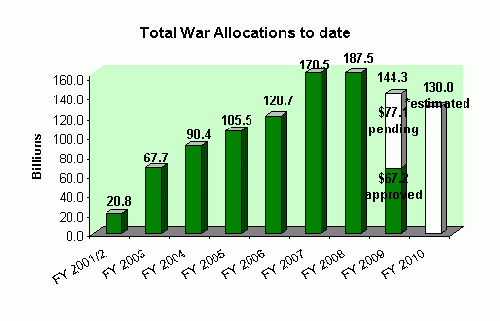
The Pentagon claims it needs to be able to fight two wars at once. However, if it did not go around starting wars it would be hard-pressed to find one. From what quarter does Gates expect an attack? Iran, with a puny military budget 1/100th our expenditure? Recall the last successful strike on U.S. soil was achieved not by a great army wielding sophisticated weapons but by a handful of terrorists with box cutters who hijacked airliners and used our own jet fuel for explosives. Yet the Pentagon expands as if gearing up to fight WWII.
“President Obama’s budget continues the decade-long uptick in Pentagon spending, which has grown by approximately 40% since 2000,” observes military policy analyst Travis Sloan of the Center For Arms Control and Non-Proliferation.
He notes the Obama budget “appears surprisingly large at first glance, especially in this economic climate.” Yet he sees reason for optimism as he believes Obama “will institute critical foreign and defense reforms that will make us safer and spend our money more wisely.” That’s his view.
Obama’s Pentagon budget, however, is certainly not going to make the people of Afghanistan safer. His buildup there comes as Afghan President Hamid Karzai pleads in the strongest terms “for the U.S. to halt air strikes in his country, following attacks…that Afghan officials said killed 147 people,” Reuters reported. “We demand an end to these operations…an end to air strikes,” Karzai told CNN. (Demand? Puppets don’t pull strings.)
Defense Secretary Gates informed West Point cadets April 21st that Afghanistan is about “striking back at the staging ground of the perpetrators of the September 11th attack,” claiming “Afghanistan is widely viewed as a war of necessity.”
In fact, USA Today reported just a month earlier that public support for that conflict “has ebbed to a new low,” according to a Gallup Poll. Americans who regard the attack on Afghanistan as “a mistake” had increased from 9% in 2001 to 42%, a sea change Gates conveniently chooses not to credit.
Gallup also discovered a shift in public opinion from March, 2007, when it asked if the U.S. was spending too much or too little on defense. Forty-three per cent responded “too much” compared with 20 percent who replied “too little.” A decade earlier most Americans didn’t think the Pentagon was on a spending binge with their taxes.
It’s ironic that to prosecute what is now President Obama’s war, the Pentagon is inflicting on Afghan civilians the same cruel deaths terrorists visited on New York City. Human Rights Watch dubbed “inadequate” U.S. military measures to safeguard them.
(Note: You can view every article as one long page if you sign up as an Advocate Member, or higher).
 2
2
 2
2
 1
1






