Tag(s): ; ; ; , Add Tags
Add to My Group(s)

View Ratings | Rate It

Permalink
View Article Stats      (15 comments)

Light is at absolute rest, and science isn't interested

Add this Page to Facebook!
Submit to Twitter
Submit to Reddit
Submit to Stumble Upon

Tell A Friend
Become a Fan
Get Embed HTML Code
By (about the author)

Become a Fan Become a Fan  (10 fans)   -- Page 2 of 5 page(s)

opednews.com

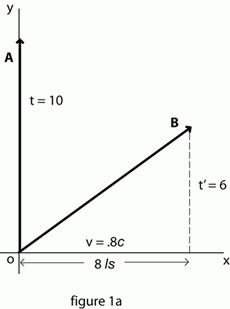
s2 = 62

Thus s, the interval as it is generally called, is represented in the diagram as the proper time of body B.

A significant implication of the diagram is that there are actually two invariants involved in a relativistic relationship: the conventionally recognized interval, the proper time of B, and in addition, the identical spacetime intervals of the world-lines of A and B. The world line of an observer is not commonly recognized as being equivalent in length to the interval of the world-line of a body being observed; but in the relationship shown in figure 1a between an observer and a body in relative motion (where t2 = s2 + x2), the spacetime interval of the observer is necessarily equivalent to any world-line in relative motion, as the latter forms the hypotenuse of the Euclidean triangle described by the observer's measure of another body's distance traveled in space and the time elapsed on the moving body's clock.

It is important to note that both the Lorentz Transformations and the equation for the invariant interval indicate a Euclidean relationship between space and time, and between bodies in relative motion. Although the relationship between clocks in relative motion given by t' = (t2-x2).5 is indeed parabolic, as is generally recognized, the fact that a hypotenuse relates to the sides of a Euclidean triangle by a parabolic function presupposes the right-angle. And as figure 1a shows, the temporal component of any body's uniform motion in spacetime is at a right-angle to the observer's space axis.

Figure 1b shows both reference frames at once, with A and B each moving in time, and perpendicular to space according to its own frame. The perpendicular relationship of a body's motion in time to its own reference in space will be significant in later considerations.


The relative motion of light as it would be represented in these terms is especially noteworthy. And it should be kept in mind that whereas the speed of light is commonly expressed as (approximately) 300,000 km per second, or 1 ls, to fully describe its observed motion relativistically is to report that it travels 1 ls in space relative to an observer's spatial reference, and zero seconds in time relative to the observer's temporal reference, as is given both by the Lorentz transformations and the equation for the spacetime interval. A world-line representing a ray of light in figure 1c, depicted below, therefore has a spacetime interval of 10 but a proper time of zero, and lies directly along the x-axis of observer A. (The interval in this case is s2 = 102 - 102.)


Two preliminary conclusions derived from these diagrams can be mentioned:

The speed of light as a limit: If the world-lines of bodies in relative motion are taken as having the same spacetime interval but with varying spatial and temporal components according to their relative spacetime trajectories, the limiting spatial velocity is the interval of a world-line along the space axis measured in terms of the same interval along the corresponding time axis. A vector drawn along the x-axis in figure 1c to represent a ray of light extends as far along the x-axis as time elapses for the observer in the duration of the diagram. There is no vector that can extend further in space than one that has a temporal component of zero.

The speed of light as invariant: Due to the invariance of the observer's and observed spacetime intervals, each observer will measure light as traveling the same distance in space as time elapses in that observer's reference frame, and though the measure of the spatial distance traveled by a beam of light between events will vary between reference frames, the rate will always be agreed upon. We can also infer from the observation of light as projected in figure 1c that distance in time is equivalent to distance in space - that one second in time is the same distance, but in a perpendicular direction, as 300,000 km in space.

The Hypothesis

The fact that the motion of material bodies is relative, and limited below c, while the motion of light is invariant, and an absolute limit c, suggests a fundamental distinction. If motion in time were to be regarded as a correlate of mass, if the clock of a material body is unable to stop entirely, and if in contrast light is massless, and its clock (if it could be said to have one) is invariably motionless, then light could be construed as actually, absolutely, not-moving in time. And if light doesn't move in time, it seems meaningless to say that it moves at all.

The question is: If light is considered to be at absolute rest, if the apparent motion of light is actually the reflection of the motion of mass in time, however absurd the idea may seem at first, then what paradoxes could be resolved, what potential exists for a more comprehensive understanding of other issues and phenomena? What if material (massive) bodies exist in spacetime, but photons are embedded in space? What would be the implications if light is at absolute rest, and if the motion of mass in time - perpendicular to space and yet always in space - is the basis of all motion, real and apparent?

To represent light in these terms, figure 1d depicts a photon B as stationary, located in space, and according to A, 10 ls distant from the origin o. B is absorbed by A as the latter moves in time at the intersection of t = 10.


Next Page  1  |  2  |  3  |  4  |  5


A former visitant of UC Santa Cruz, former union boilermaker, ex-Marine, Vietnam vet, anti-war activist, dilettante in science with an earth-shaking theory on the nature of light (which no one will consider), philosopher in the tradition of Schelling, Hegel, Merleau-Ponty, Marx, and Fromm (sigh, no one listens to me on that either), author of a book on wine clubs (ahem), and cast-off programmer of ancient computer languages.


The views expressed in this article are the sole responsibility of the author
and do not necessarily reflect those of this website or its editors.

Contact Author Contact Editor View Authors' Articles


Share this page: (what's this?)                   Tell a Friend: Tell A Friend

Add this Page to Facebook!      Submit to Stumble Upon      Submit to Reddit      Add This Page to Mr Wong!           NEWSVINE      DEl.ICIO.US      Looksmart Furl      My Web      Blink List     (More...)

Comments

The time limit for entering new comments on this article has expired.

This limit can be removed. Our paid membership program is designed to give you many benefits, such as removing this time limit. To learn more, please click here.

Comments: Expand   Shrink   Hide  
15 comments
To view all comments:
Expand Comments
(Or you can set your preferences to show all comments, always)

Additional Observations by Scott Baker on Friday, Aug 14, 2009 at 2:45:48 PM
re: Additional Observations by Jim Arnold on Friday, Aug 14, 2009 at 3:10:12 PM
Additional Observations by Scott Baker on Saturday, Aug 15, 2009 at 2:45:12 AM
additional clarifications by Jim Arnold on Saturday, Aug 15, 2009 at 5:57:14 PM
If light is at rest, by Stanimal on Friday, Aug 14, 2009 at 6:56:49 PM
why if light is at rest... by Jim Arnold on Friday, Aug 14, 2009 at 9:27:50 PM
a little more explanation... by Jim Arnold on Friday, Aug 14, 2009 at 10:14:12 PM
Another Time... by Scott Baker on Saturday, Aug 15, 2009 at 3:03:57 AM
Another time, another place by Jim Arnold on Saturday, Aug 15, 2009 at 4:22:42 AM
What Light Is by Hoss Hoss on Saturday, Aug 15, 2009 at 8:15:07 AM
What it is by Jim Arnold on Saturday, Aug 15, 2009 at 6:15:50 PM
You read by Hoss Hoss on Thursday, Aug 27, 2009 at 4:54:30 PM
Re: You read by Jim Arnold on Thursday, Aug 27, 2009 at 5:57:41 PM
Light by thomas unger on Saturday, Aug 15, 2009 at 10:30:16 AM
Much truth by Jim Arnold on Saturday, Aug 15, 2009 at 6:37:43 PM